Three-dimensional tetrahedral Darcy
The native three-dimensional primal MHM solver uses straight-sided tetrahedral macrocells, continuous local Pk pressure, and piecewise polynomial normal flux densities on triangular subdivisions of each macroface. The skeletal space can be discontinuous or continuous within a macroface, independently for each face. It solves
with symmetric positive-definite scalar or tensor permeability. Pressure data
are imposed weakly through skeletal moments. Prescribed Neumann data are outward
physical normal fluxes; pure Neumann problems require compatible data and one
physical volume mean. The raw field -K grad(p) is generally broken across
macrofaces. Conservation concerns the oriented skeleton flux, and does not
assert fine-cell conservation of that raw gradient.
Positive local degrees are supported. The general tetrahedral Pk study includes independent P5/P6 element checks and a P5/P2 estimator campaign.
The example helpers below are repository sources, supplied separately from the installed library. Open the corresponding notebook to acquire its verified companion, as described in the notebook guide.
from pymhm.meshes.tetrahedron import TetraMesh
from pymhm.fem.traces.triangle_3d import TriangularSkeleton
from examples.formulations.application import tetrahedral_darcy as solve_darcy_3d

mesh = TetraMesh.unit_cube(2)
skeleton = TriangularSkeleton(mesh, subdivisions=2)
solution = solve_darcy_3d(
    mesh,
    skeleton=skeleton,
    degree=2,
    local_refinement=4,
    source=1.0,
    dirichlet=0.0,
)
subdivisions=2 creates four constant trace modes on each macroface;
subdivisions=4 creates sixteen. A sequence can assign different subdivisions
per face. Local refinement and skeletal subdivisions are dyadic, and the fine
boundary triangulation must resolve the trace partition. These counts describe
mesh subdivisions, not polynomial degree. Local P2 functions include topologically
shared edge midpoints; P3/P4 also share topologically identified face nodes.
TriangularSkeleton(mesh, degree=1) selects three independent linear Bernstein
modes per subtriangle, independently of the local degree. Refinement preserves triangular interface alignment and
oriented normals without merging geometrically close unrelated vertices.
Continuous polynomials within each macroface
continuous=True shares the polynomial trace degrees of freedom along the
internal edges and vertices of a macroface partition. Distinct macrofaces keep
separate coordinates, including at their shared macroedges and macrovertices.
This is continuity of the normal-flux density within one face, not a globally
continuous pressure trace. The latter is the separate variable used by MH²M.
skeleton = TriangularSkeleton(mesh, subdivisions=2, degree=1, continuous=True)
solution = solve_darcy_3d(
    mesh, skeleton=skeleton, degree=3, local_refinement=2,
    source=1.0, dirichlet=0.0,
)
For this uniform partition, continuous P1 has six coordinates per macroface;
the default discontinuous P1 space has twelve. Both represent densities with
respect to the original face's canonical normal. continuous accepts a boolean
or one boolean per macroface, so a single skeleton can mix the two spaces.
degree likewise accepts independent face degrees. Every degree \(k\geq1\)
is available for a continuous face; degree zero remains available for
discontinuous faces. P1 in this example is a choice, not a maximum degree.
Explicit face partitions support the same choice.
The face-based MHM construction of Paredes, Valentin and Versieux defines continuous piecewise polynomial multipliers on independently partitioned macrofaces. Its author preprint, §2.1 and §3.2, equation (22), covers dimensions two and three. The published numerical examples are two-dimensional. The present tetrahedral controls are original implementation checks, not a reproduction of those examples. The analytical local Neumann maps in the paper and their regularity hypotheses remain distinct from finite local Galerkin approximations. A face choice still needs adequate local trace resolution and rank; selecting continuous polynomials alone does not establish a mesh-uniform stability estimate.
The continuous-macroface notebook solves the same affine patch with discontinuous, continuous, mixed-continuity and independent-degree face spaces through the generic formulation helper. It compares physical pressure and flux norms and checks the integrated macro balances. Canonical RT moment reconstruction also accepts the shared coefficients. The published energy estimator requires independent polynomial tests on each skeletal subface and excludes subdivided continuous faces; an algebraic reconstruction does not imply that estimate.
The affine pressure is \(p=1+x+2y+3z\) with identity permeability, zero source and its nonhomogeneous Dirichlet data. Six macrotetrahedra use two local edge subdivisions. The executed notebook gives:
| Face space | Local degree | Skeletal coordinates | Pressure L² error | Physical flux L² error | Maximum macro imbalance |
|---|---|---|---|---|---|
| DG P1 | 3 | 216 | 1.23e−14 | 2.25e−13 | 3.16e−15 |
| C0 P1 | 3 | 108 | 3.47e−15 | 4.20e−14 | 3.05e−15 |
| C0 interior / DG boundary | 3 | 180 | 7.43e−15 | 1.37e−13 | 3.22e−15 |
| C0 P1/P2 by face | 4 | 189 | 8.06e−15 | 1.29e−13 | 9.21e−15 |
Coordinate counts precede boundary treatment and exclude local setup work. These exact-field checks verify representation, orientations and macro conservation; they do not establish convergence or uniform stability.
This convenience solver uses affine tetrahedral Pk local spaces for any positive degree; P5/P6 native checks and a P5/P2 study document the general-degree evaluation. Separate interfaces provide star-shaped polyhedral macrocells and three-dimensional H(div) mixed local families. Curved tetrahedral geometry is not part of this primal solver. The MPI assembly interface accepts generic local algebra, while this convenience driver exposes serial, thread and spawned-process local factories with a single-process global solve. The three-dimensional RAD case uses the same geometric and polynomial spaces with the conservative Robin formulation and local P4/face P1 degrees.
Explicit face and volume partitions
TriangularSkeleton(mesh, degree=k, face_partitions=parts) accepts one conforming
triangulation per original macroface. Each entry has shape (nsub, 3, 3), with
three barycentric coordinates per vertex in the order mesh.faces[face].
Subtriangles can have different areas and independently ordered vertices.
face_partition(face) returns the active triangles and face_weights(face)
returns their positive fractions of the original face area. The uniform
subdivisions setting remains available and does not replace explicit geometry.
solve_darcy_3d(..., local_meshes=locals) accepts one TetraMesh per macrocell.
Containment, total volume and the complete exterior envelope are checked;
matching total volume alone cannot authorize a hole or an unmatched interior
face. Every local exterior triangle must lie in exactly one skeletal
subtriangle. An explicit mesh therefore needs no dyadic refinement count, but
must resolve the actual face partition. Local spaces still need sufficient
trace rank; geometric alignment alone does not establish stability.
Boundary loads, macro conservation, MsHHO face moments and the three-dimensional stress/flux consumers use the subtriangle area fractions. Tests include a nonuniform face fan with fractions 0.5, 0.2 and 0.3, anisotropic affine and quadratic pressure, mixed and pure Neumann data, canonical RT reconstruction, and ordered thread/process assembly. The quadratic check has varying normal flux and distinguishes the physical weighted mean from an unweighted average.
Sinusoidal cube problem
The analytical field is
on the unit cube with homogeneous pressure data. This is the PDE in the 3D performance example of Gomes et al. (2017, preprint v1), §5. The present study uses Freudenthal macrotriangulations and deterministic local red refinement: six macrotetrahedra per Cartesian cube, 64 fine tetrahedra and 165 P2 unknowns per macrocell, with four P0 trace subtriangles per macroface. The paper uses different TetGen meshes. Consequently this is an analytical convergence verification of the same PDE and polynomial families, not a reproduction of its cluster timing table.
| Cartesian subdivisions | Macro tetrahedra | Fine tetrahedra | Pressure L² error | Physical flux L² error |
|---|---|---|---|---|
| 1 | 6 | 384 | 1.19499965e-1 | 1.83603984 |
| 2 | 48 | 3,072 | 5.86591114e-2 | 1.31206785 |
| 3 | 162 | 10,368 | 2.19302284e-2 | 7.50342855e-1 |
| 4 | 384 | 24,576 | 1.17889403e-2 | 5.40942569e-1 |
| 5 | 750 | 48,000 | 7.34105258e-3 | 4.23102134e-1 |
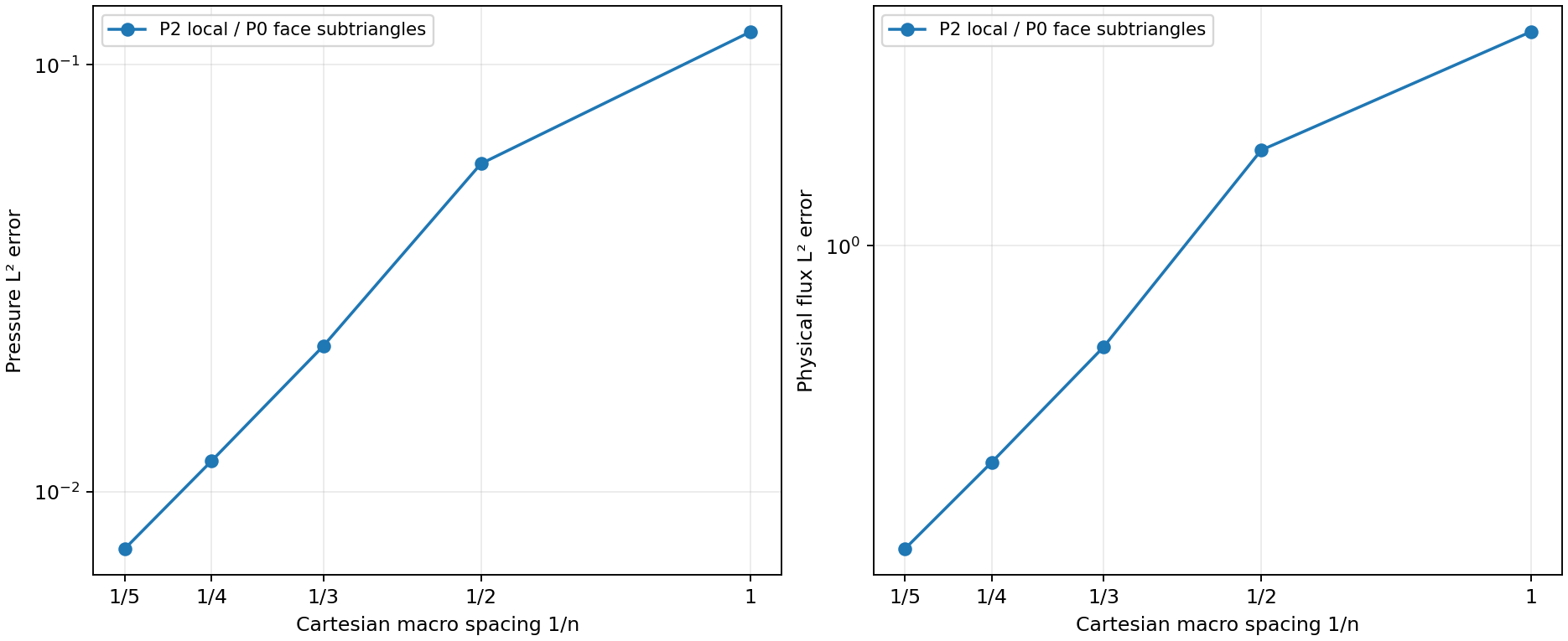
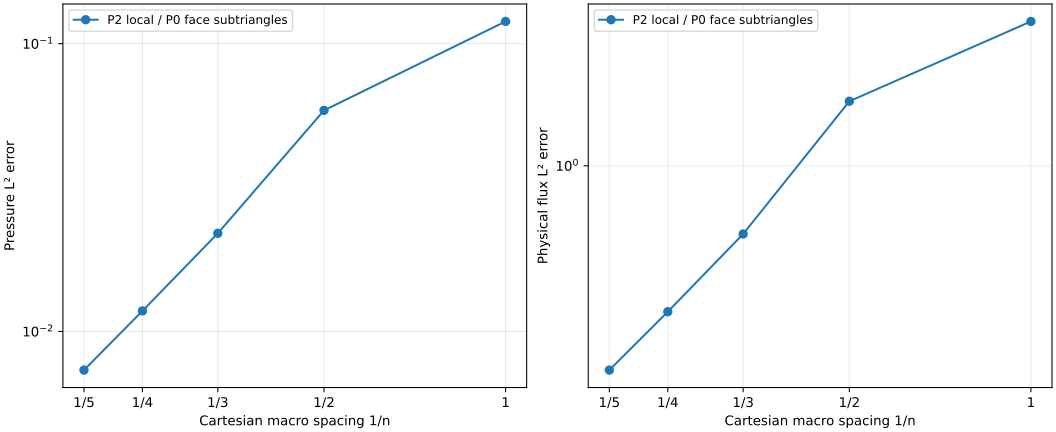
Convergence figure as SVG.
Both local and trace mesh diameters decrease as the macro mesh is refined.
The study does not isolate a pure polynomial-degree or pure skeleton-refinement
rate. The largest macrocell flux/source imbalance is below 6e-16; the largest
condensed backward residual is below 3e-16. Positive Duffy-product quadrature
uses order five for assembly and six for volumetric errors. At the finest level,
order eight changes pressure and flux error norms by less than 2e-13 in
absolute value. This checks the reported error integration; it is not a
substitute for discretization refinement.
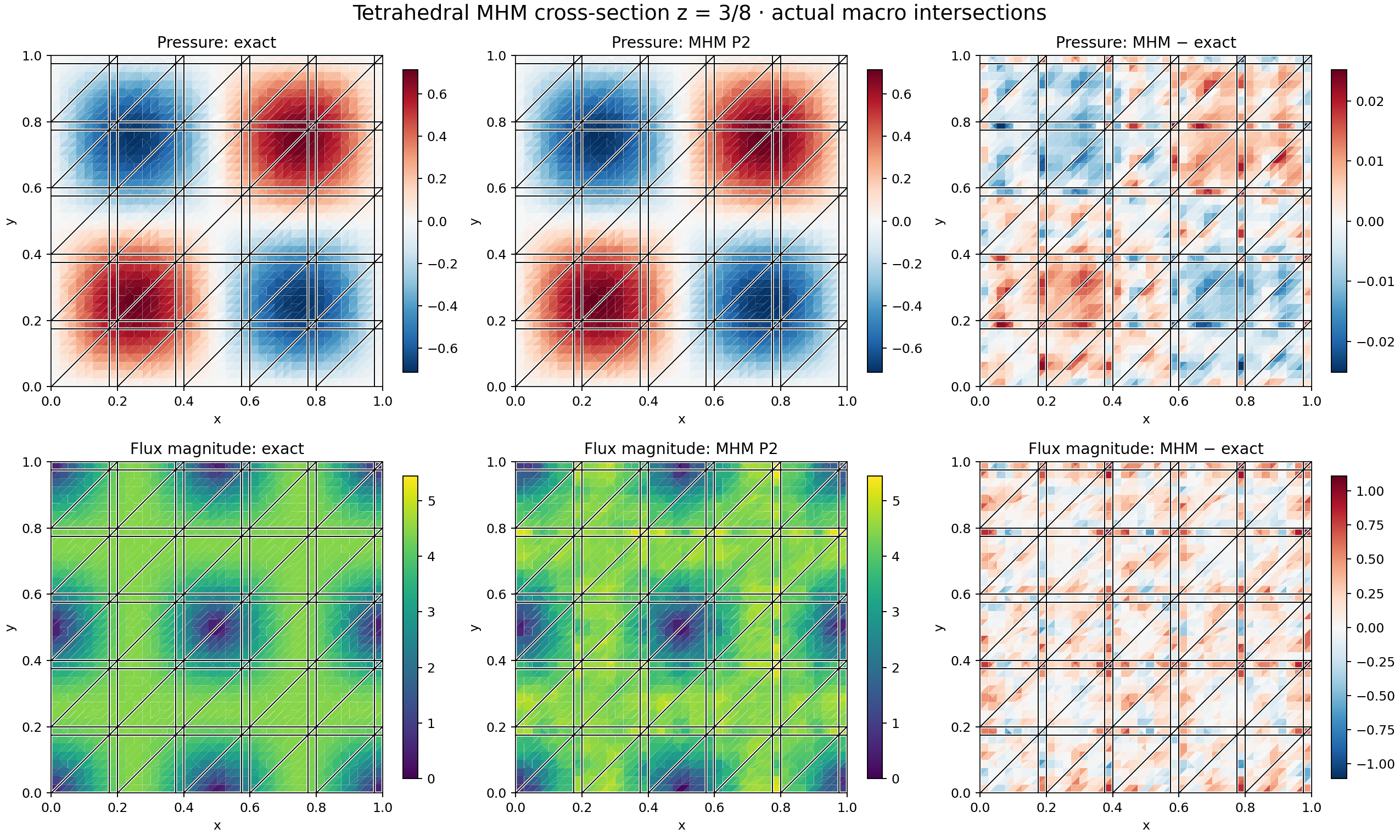
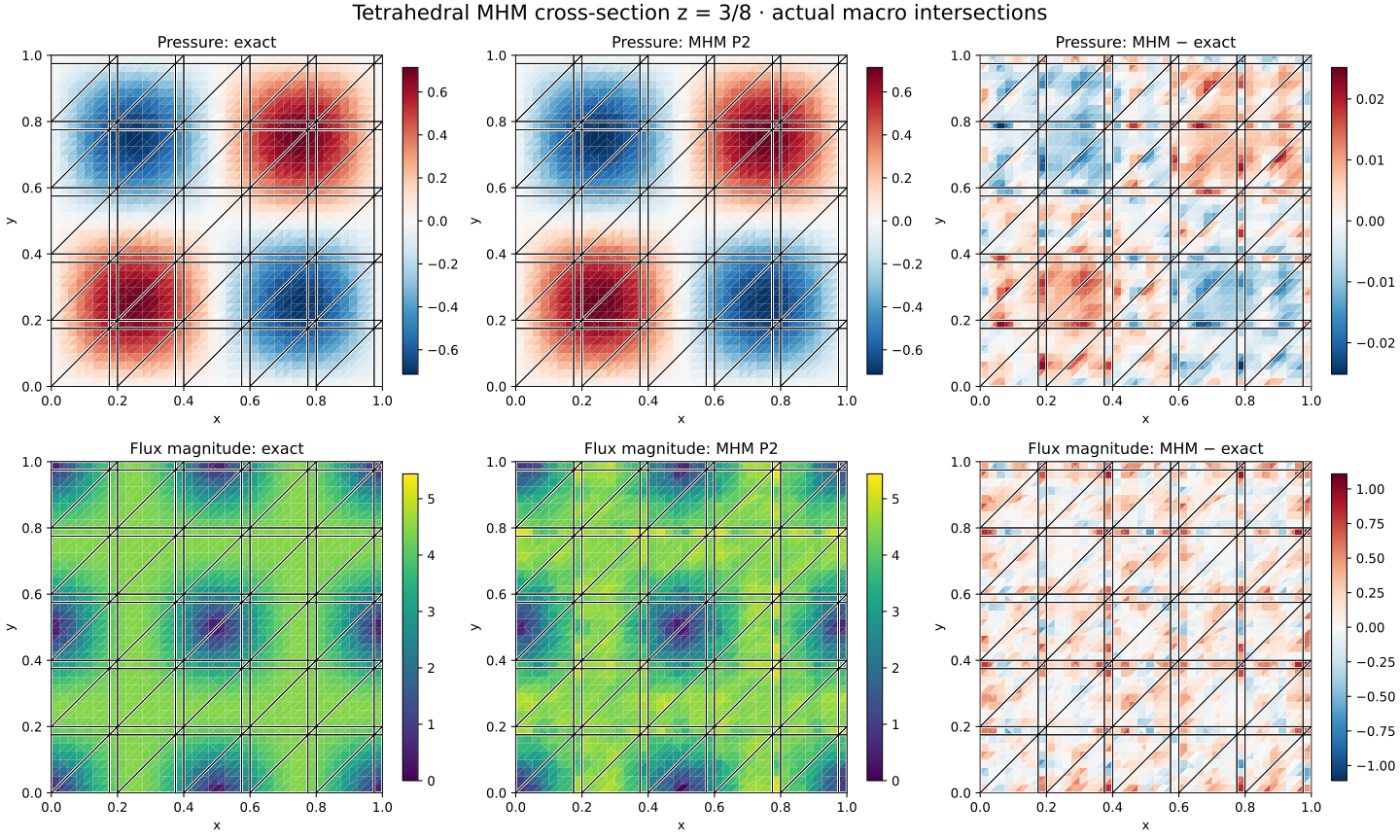
Field figure as SVG. Black lines with white outlines mark intersections of the actual tetrahedral macro mesh with the plane. Each cut fine-cell polygon displays the value at its own centroid; no averaging combines opposite sides of an interface. The same sampling and color limits are used for exact and numerical panels, and signed differences use a centered scale. These flat polygon displays approximate the visualization of P2 fields; the error norms above integrate the full polynomial and its gradient throughout the volume.
Verification and mesh exchange
Light tests cover geometric volume/orientation and surface divergence identities, positive polynomial quadrature, anisotropic affine patches, an exactly represented quadratic potential, mixed and pure Neumann data, physical gauges, invalid trace partitions, and equality with a directly assembled uncondensed saddle system. Thread and spawn-process results coincide with serial fields. Native optional tests compare the P1/P2 volume matrices and loads with independent DOLFINx/UFL assembly on a distorted tetrahedron, matching DOFs by coordinates.
pymhm.io.tetrahedral.read_tetra_mesh and write_tetra_mesh exchange linear tetrahedra
through meshio, including integer material and triangular-face IDs and finite
point/volume fields. A native VTU roundtrip verifies geometry, tags and fields.
Gmsh tetrahedral files can be imported through meshio; this does not add a
three-dimensional CAD-generation wrapper. Higher-order geometric cells, prisms,
hexahedra and polyhedra are explicitly rejected by this tetrahedral reader.
pixi run --locked -e test-core python -m examples.solve_darcy3d
pixi run --locked -e notebooks python -m examples.plot_darcy3d
pixi run --locked -e fem pytest tests/test_tetrahedral.py -m fem
pixi run --locked -e meshing pytest tests/test_meshing3d.py -m meshing
Acquisition record
and notebook 29_darcy3d.ipynb retain the discretization, source hashes and checks.
References
- Antônio Tadeu A. Gomes, Weslley S. Pereira, Frédéric Valentin, and Diego Paredes (2017). On the Implementation of a Scalable Simulator for Multiscale Hybrid-Mixed Methods, arXiv preprint, version 1, 30 March 2017. arXiv: 1703.10435v1.
- Diego Paredes, Frédéric Valentin, and Henrique M. Versieux (2024). Revisiting the robustness of the multiscale hybrid-mixed method: The face-based strategy, Journal of Computational and Applied Mathematics 436, 115415. DOI: 10.1016/j.cam.2023.115415.