Tetrahedral flux reconstruction and adaptive resolution
The three-dimensional construction uses the canonical Raviart–Thomas moments and energy decomposition of Barrenechea et al. (2026). Their analysis explicitly treats dimensions two and three. This page uses analytical cube problems to verify the three-dimensional implementation; these are not historical numerical figures from the paper.
Spaces and physical conventions
The pressure solves
The local continuous space has degree \(k\), the macroface normal-flux space has degree \(\ell\), and the reconstructed space is \(\mathrm{RT}_m\) on every fine tetrahedron. The sufficient polynomial condition in Theorem 5.2 is
Thus a tetrahedral estimator with constant skeletal traces requires at least local \(P_3\). A degree-one skeletal space requires at least local \(P_4\). The reported uniform and adaptive estimator sequences use local \(P_3\), eight fine tetrahedra per macrocell, skeletal \(P_0\), and RT1 reconstruction. The API checks the spatial dimension explicitly. Canonical RT moment construction itself has a weaker algebraic requirement; its existence alone does not establish the hypotheses of this error estimate.
Theorem 4.7's approximation bound also assumes diffusion polynomial on each fine tetrahedron and the stated piecewise pressure/conormal regularity. Identity diffusion and both analytical solutions below satisfy these conditions. Raw-divergence rates require the additional source regularity and quasi-uniform size relation; they do not follow solely from the degree inequality. Reliability and efficiency have separate hypotheses, stated in Barrenechea et al. (2026), Theorem 5.2.
The theorem's skeletal space has independent polynomial tests on each
subtriangle. The local efficiency argument uses a constant test supported on
one such subface to obtain its zero mean pressure jump. A continuous macroface
with several subtriangles does not contain those tests and is rejected by
estimate_darcy_error_3d. A continuous face with one subtriangle has the same
polynomial space as a discontinuous face. reconstruct_darcy_moments_3d
remains available for subdivided continuous traces; its shared-coefficient
evaluation establishes an algebraic reconstruction, not the cited estimate
for that different test space.
Boundary RT moments equal the physical skeletal flux moments. Interior fine-face moments use the arithmetic average of the two incident raw fluxes, with their separate material traces. Interior vector moments use the raw physical gradient. No display interpolation enters these equations.
The reconstruction satisfies
These are continuous-test moments. They do not impose a separate source balance on every fine tetrahedron. Numerical records retain both diagnostics.
Exact solutions and integration
For the uniform sequence, use \(p(x,y,z)=\sin(\pi x)\sin(\pi y)\sin(\pi z)\). The localized adaptive problem is
Analytical derivatives supply the source and all three physical flux components. The independently integrated exact norms for the localized problem are \(\lVert p\rVert_{L^2}=0.1216558888886656\) and \(\lVert q\rVert_{L^2}=1.2583314573562623\). The reference norm integration uses tensor Gauss rules of orders 32 and 40; independent separable one-dimensional quadrature confirms these values. Reported relative errors divide by these physical volume norms.
Assembly and estimation use quadrature order 12. Error norms use two independent orders, 12 and 14. The records retain their differences. These are numerical quadrature checks, not interval-certified integral bounds.
Uniform and adaptive estimator studies
The uniform sequence uses \(n=1,2,3,4,5\), with \(6n^3\) macrotetrahedra. The adaptive sequence starts from 48 macrotetrahedra, selects a minimal Dörfler bulk set with \(\theta=0.5\), and bisects conforming edge stars. The geometry transfer preserves parent volumes, boundary labels and physical Neumann data when present. This refinement policy is an original implementation; no optimal-complexity or shape-regularity theorem is inferred from this sequence.
The four terms are the material-weighted flux defect, Oswald nonconformity, continuous-projection divergence defect and data oscillation. For identity diffusion their normalization coincides with the printed estimator. The effectivity divides the total indicator by the independently integrated broken energy error. Indicator reduction and field accuracy are reported separately.
| Uniform macrocells | Relative pressure error | Relative RT1 flux error | Effectivity |
|---|---|---|---|
| 6 | 44.6844% | 60.8519% | 3.3788 |
| 48 | 33.3879% | 48.6713% | 1.7437 |
| 162 | 15.8995% | 33.7506% | 1.6595 |
| 384 | 9.1702% | 25.6828% | 1.6448 |
| 750 | 5.9378% | 20.6871% | 1.6405 |
The final uniform interval gives observed orders 1.95 for pressure and 0.97 for RT1 flux when measured against \(H=1/n\). The constant skeletal space remains a low-order approximation even with cubic local pressure. These five points verify decreasing errors and measured effectivity; they do not make the finest field an accurate reference solution.
For the localized problem, all eight adaptive states retain the same P3/P0/RT1 degrees and eight fine tetrahedra per macrocell. The indicator \(\eta\) below is an absolute energy-scale quantity. Its effectivity is \(\eta/\lVert\nabla(p-p_h)\rVert_{L^2(\mathcal T_H)}\), rather than a ratio to the reconstructed-flux error.
| State | Macrocells | Relative pressure error | Relative RT1 flux error | Indicator \(\eta\) | Effectivity |
|---|---|---|---|---|---|
| 0 | 48 | 122.6317% | 102.2120% | 5.363611 | 4.2811 |
| 1 | 54 | 112.5743% | 97.8426% | 4.088370 | 3.4179 |
| 2 | 74 | 81.0567% | 82.0158% | 2.528290 | 2.4889 |
| 3 | 114 | 67.2968% | 72.6131% | 2.079804 | 2.2978 |
| 4 | 177 | 45.8101% | 60.6013% | 1.671476 | 2.2074 |
| 5 | 280 | 29.0417% | 47.2582% | 1.217821 | 2.0604 |
| 6 | 464 | 21.4581% | 41.4809% | 1.108717 | 2.1317 |
| 7 | 734 | 16.7026% | 36.4593% | 0.983538 | 2.1498 |
Macro refinement reduces the indicator by 81.66% and both physical errors decrease throughout the sequence. Nevertheless, the final constant-trace field still has a 36.46% reconstructed-flux error. The raw-flux error is similarly large, 36.36%, so reconstruction alone does not resolve this approximation. The final nonconformity term is 0.961622, the largest estimator contribution. Effectivity remains above one in these measurements but is not monotone. The sequence verifies estimator-guided refinement under the stated degree conditions; it does not establish that this macro budget sufficiently resolves the localized solution.
The maximum continuous-test equilibrium residual over the eight states is \(1.63\times10^{-15}\), and the largest absolute change in the error norms between quadrature orders 12 and 14 is \(1.46\times10^{-10}\). These checks distinguish algebraic equilibrium and integration from the remaining physical approximation error. The fixed-geometry comparisons below separately test the effect of enriching the constant skeletal space.
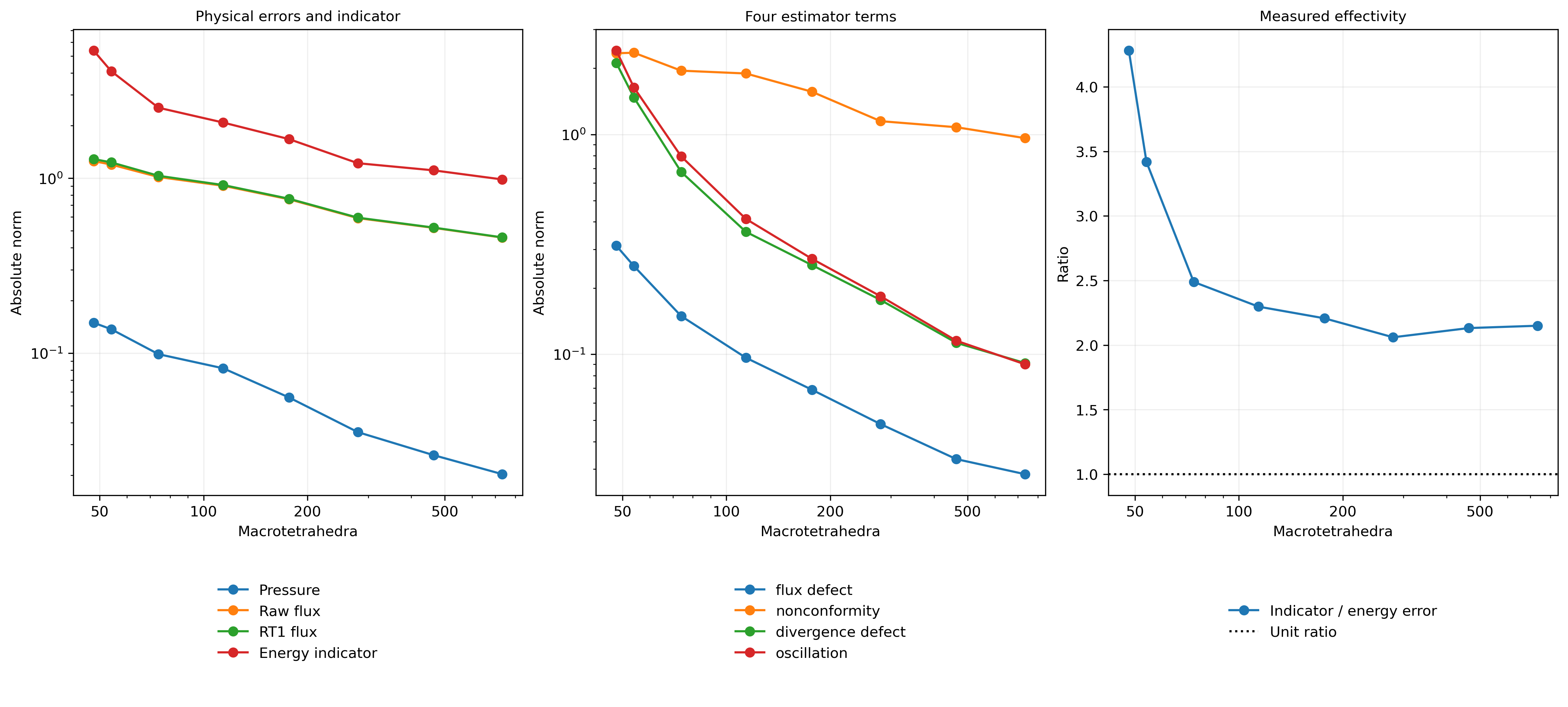
The second figure shows the 734-macrocell constant-trace state from the table, including its signed errors. The enriched P4/P2 fields later on this page belong to a separate approximation-space study.
Local and skeletal resolution
A separate fixed-macrogeometry comparison changes local and skeletal spaces independently. Raising the local degree while retaining one constant flux coefficient per macroface need not resolve the physical field. The trace comparison therefore includes quadratic modes and subface refinement, with unchanged geometry, source and material.
All configurations use the same 162 macrotetrahedra and eight local tetrahedra per macrocell. Subdivision \(s=2\) divides each triangular macroface into four triangular subfaces. The table reports relative volume \(L^2\) errors.
| Local pressure | Trace degree | Subdivision | Global trace DOFs | Pressure | Raw flux | Reconstructed flux |
|---|---|---|---|---|---|---|
| P2 | 0 | 1 | 351 | 56.0870% | 65.1609% | 65.5165% (RT1) |
| P4 | 0 | 1 | 351 | 56.1706% | 64.8769% | 65.4013% (RT1) |
| P4 | 2 | 1 | 2,106 | 2.0470% | 6.1738% | 6.9367% (RT2) |
| P4 | 2 | 2 | 8,424 | 0.1598% | 1.0871% | 3.2424% (RT2) |
| P4 | 2 | 2 | 8,424 | 0.1598% | 1.0871% | 2.0420% (RT3) |
The nearly unchanged errors in the first two rows identify a limitation of the constant macroface trace. Adding quadratic trace modes and then subfaces resolves the localized field. Reconstruction does not minimize the physical flux error: its prescribed normal and interior moments can produce a larger \(L^2\) error than the raw gradient. In particular, RT2 does not contain the complete cubic gradient space of a P4 pressure.
The RT3 row reconstructs the same archived P4 solution, without another primal solve. RT3 contains its cubic raw gradient, but the prescribed macroface moments and averaged interior-face moments can still change that gradient. Here the higher reconstruction order reduces the physical error from 3.2424% to 2.0420%; it does not reach the raw-gradient error. Its maximum continuous-test equilibrium residual is \(2.43\times10^{-15}\), while its maximum fine-cell source-balance defect is \(9.83\times10^{-4}\). These measure different conditions.
This control uses error quadrature orders 10 and 12; the largest absolute norm difference is \(2.14\times10^{-10}\). The maximum integrated macrocell balance residual is \(1.95\times10^{-16}\). Balance is a separate invariant and does not explain the substantial accuracy differences between these spaces.
This comparison evaluates physical errors directly. A \(P_4/P_2\) local/trace pair is not assigned the estimator theorem above, which requires \(P_5\) for \(\ell=2\) in three dimensions. This distinction preserves both the valid approximation experiment and the theorem's actual hypotheses. The P5/P2 study supplies the corresponding admissible degree pair, with five uniform macro resolutions and a separate RT2/RT3 comparison on the same 162-macrocell geometry.
Fields and one-sided profiles
An independent DOLFINx/UFL assembly constructs the uncondensed saddle matrix, including stiffness, source, physical face normals and Bernstein trace moments. Five comparisons cover \(P_2/P_0\), \(P_3/P_0\) and \(P_4/P_2\) local/trace pairs on 6 or 48 macrotetrahedra. The largest full system has 8,640 unknowns. Maximum relative coefficient differences are \(2.18\times10^{-13}\) for pressure and \(1.50\times10^{-13}\) for the multiplier; the largest complete system residual is \(8.31\times10^{-15}\). The native verification record states the operators, integration and versions. These comparisons verify the discrete equations independently of condensation. They are distinct from the physical approximation errors and do not remove the degree hypotheses above.
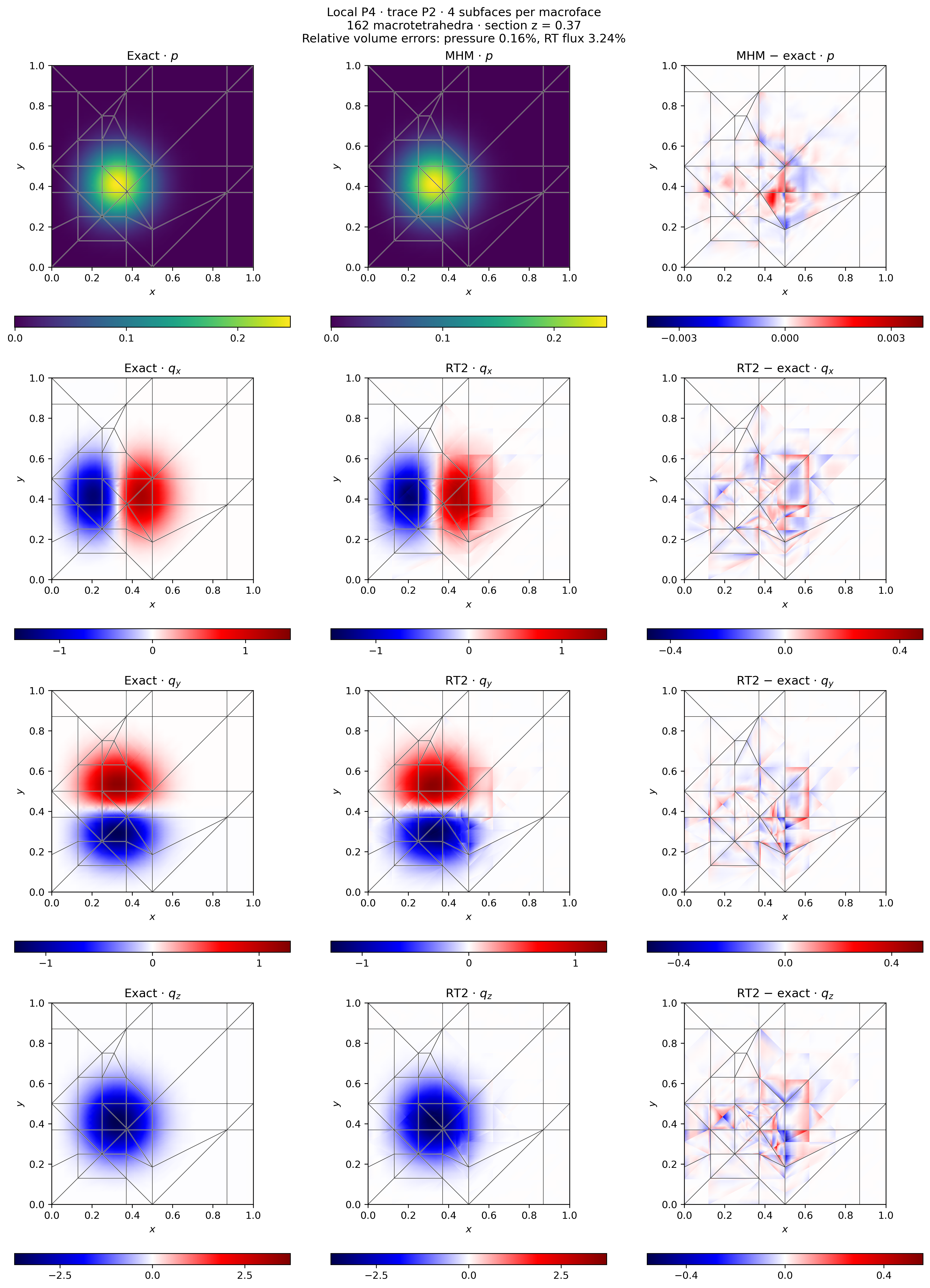
Spatial panels evaluate complete local pressure and RT polynomials on the section \(z=0.37\). The executed RT basis matrix is stored with its coefficients and used consistently in moment orientation and Piola evaluation. Analytical and numerical fields share scales. Signed components use symmetric limits about zero; error panels use separately labeled symmetric scales. The original macroface intersections remain visible in every panel.
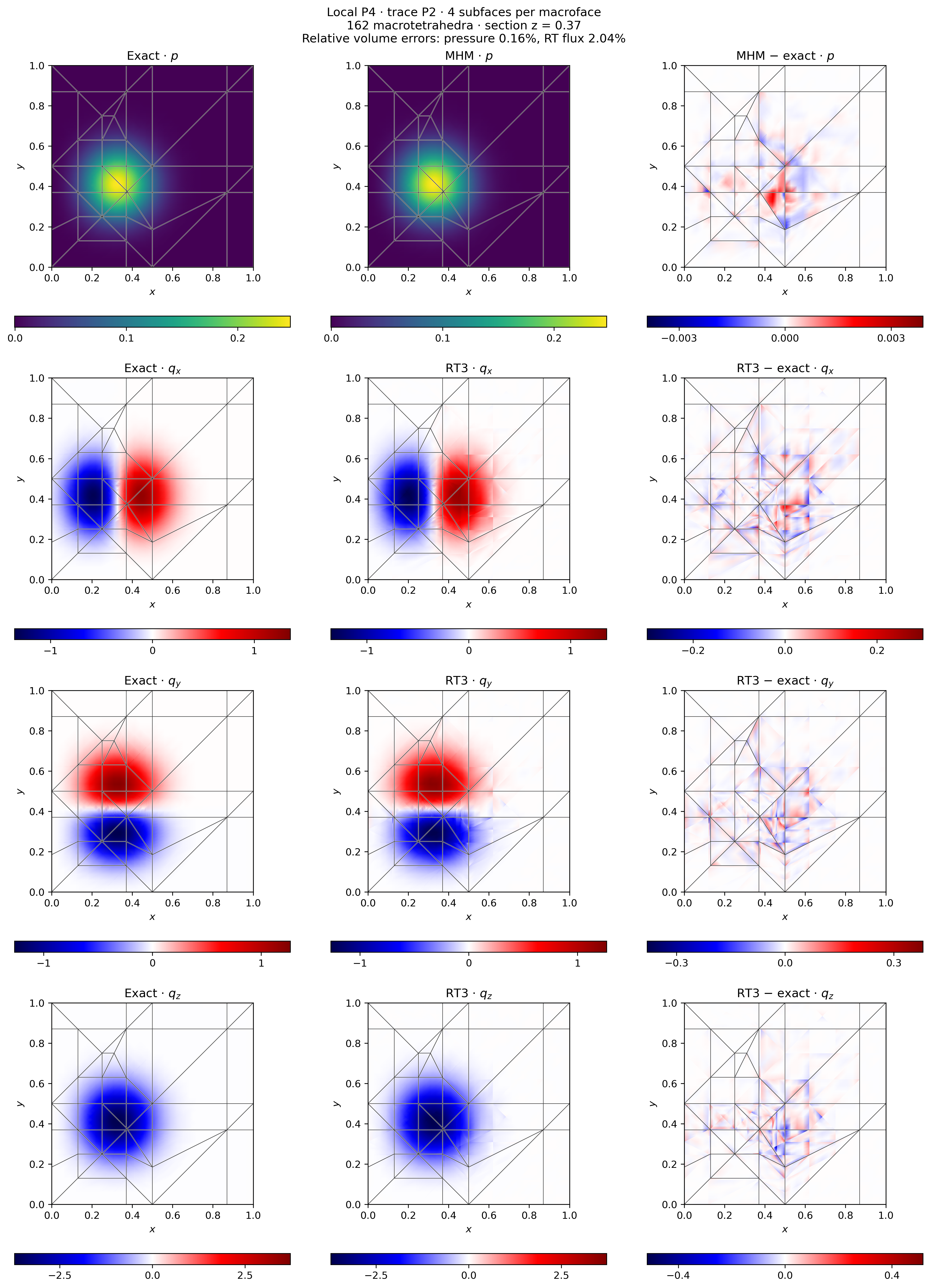
The field panels use the final P4/P2 configuration in the table, with four subfaces per macroface and RT3 reconstruction. They show pressure and every signed flux component, with independent error color scales.
The RT2 field panels show the same pressure solution with the lower reconstruction order.
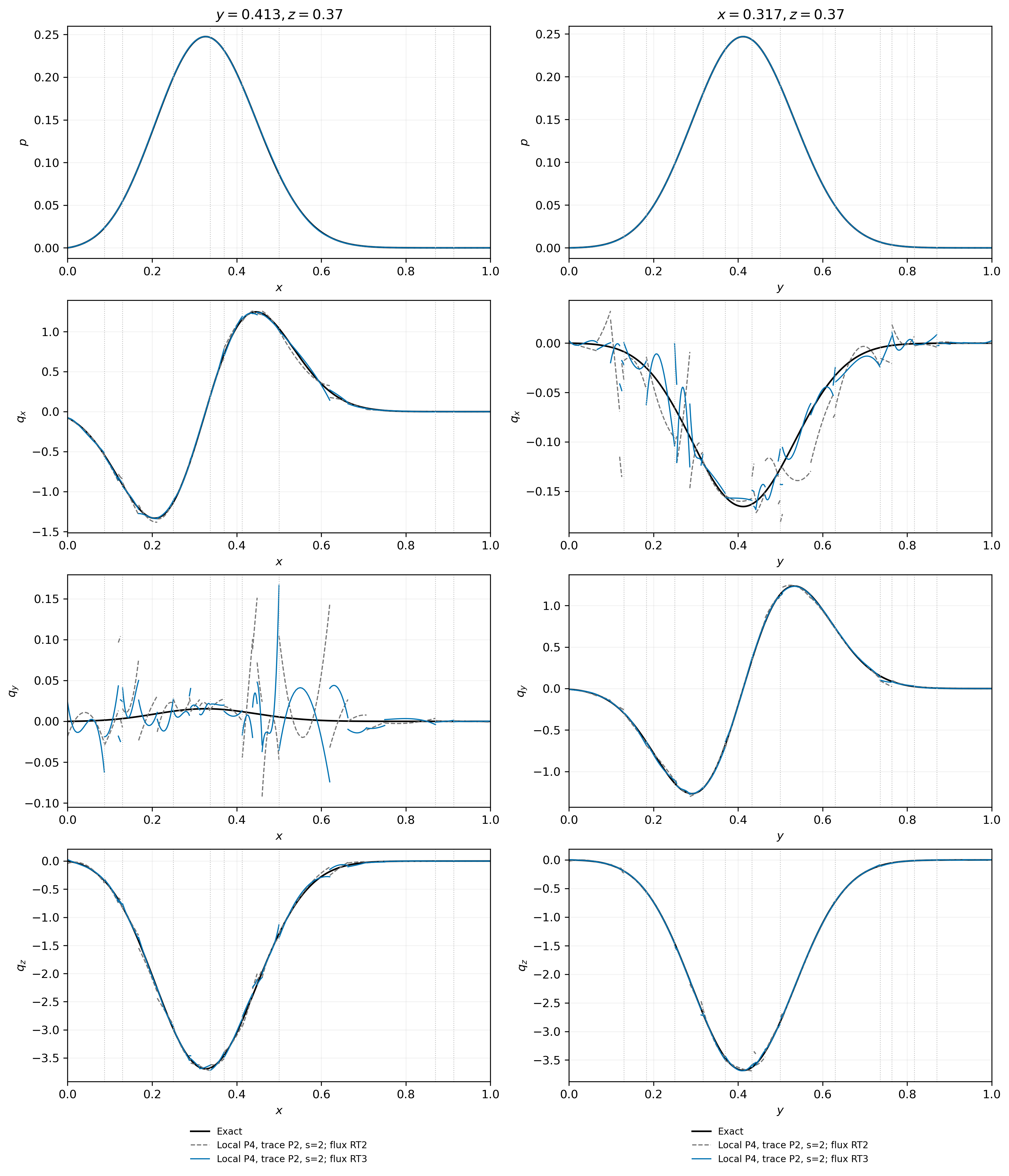
Profiles cross the section along \(y=0.413\) and \(x=0.317\). Every fine-cell segment retains its own endpoint values. Consequently jumps in pressure or tangential flux remain visible instead of being averaged across interfaces. Vertical dotted lines identify macroface intersections. The profiles compare RT2 and RT3 on the same P4/P2 solution with four subfaces per macroface. The field replay record identifies the acquired coefficients, executed bases and agreement with the physical errors in the original table.
Reproduce
Run the estimator sequences and the separate approximation-space comparison:
pixi run --locked -e notebooks reconstruction3d-uniform
pixi run --locked -e notebooks reconstruction3d-adaptive
pixi run --locked -e notebooks reconstruction3d-resolution
pixi run --locked -e notebooks reconstruction3d-rt-order
pixi run --locked -e notebooks gallery-reconstruction3d
The resolution comparison uses the fixed geometry in
examples/data/reconstruction3d-macro.json, independently of the adaptive run.
Numerical JSON and NPZ records live in examples/results/reconstruction3d.
Each record includes source hashes, space choices, integration controls and
field archive digests.
The complete downloadable records are the uniform estimator sequence, eight-state adaptive sequence, fixed-geometry resolution comparison and RT3 reconstruction of the unchanged P4 field. Their recorded source guards report no changes during acquisition.
References
- Gabriel R. Barrenechea, Larissa Martins, Weslley Pereira, and Frédéric Valentin (2026). An H(div; Ω)-Conforming Flux Reconstruction for the Multiscale Hybrid-Mixed Method, Multiscale Modeling & Simulation 24(2), 399–428. DOI: 10.1137/24M1673073.