Flow around a low-permeability obstacle
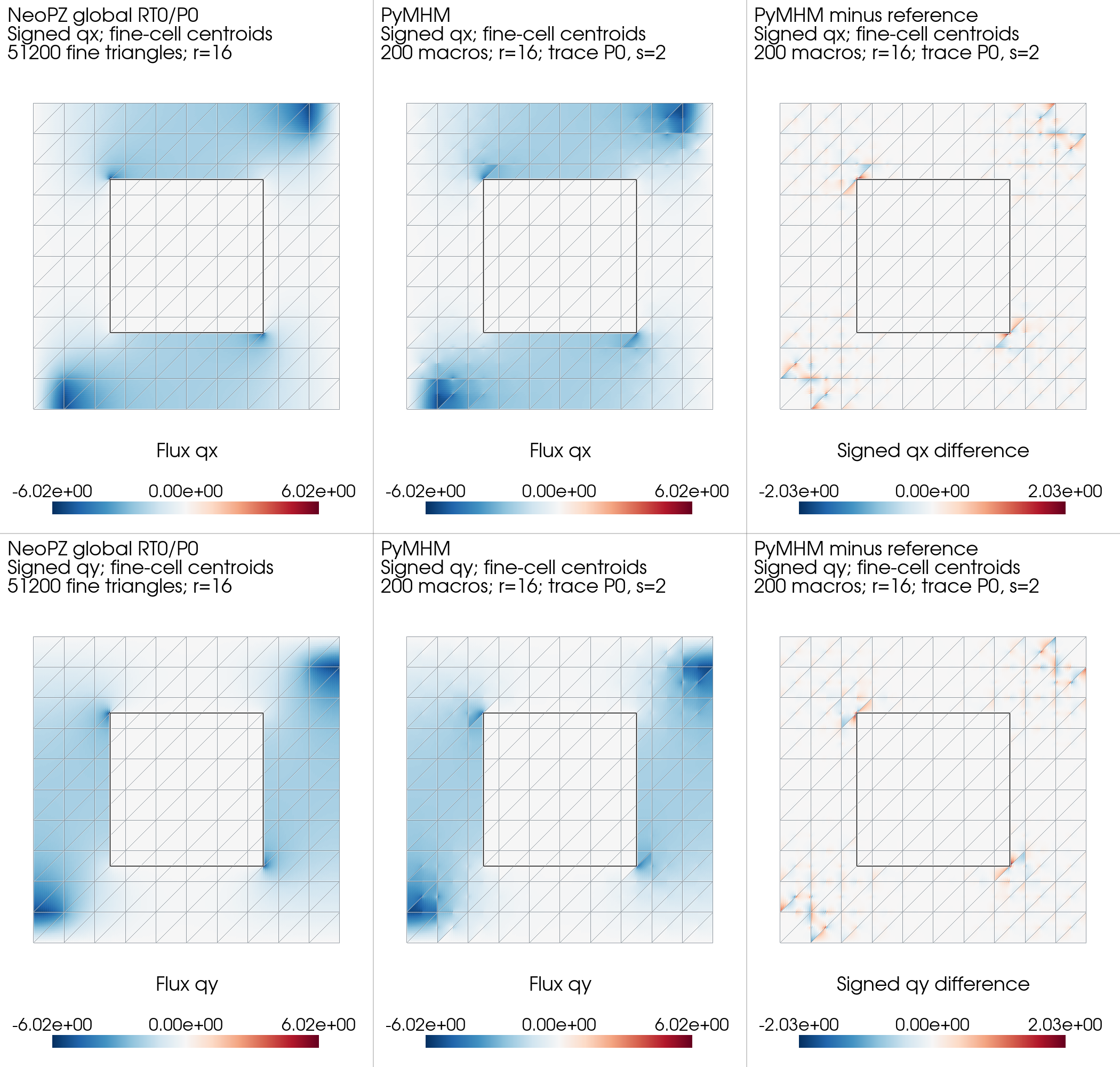
A central barrier redirects Darcy flow between an injection region and an extraction region. The barrier crosses macroelement interiors, while local fine meshes retain both materials. This application illustrates the effect of resolving a material intersection in the macroface trace space.
Physical problem
On the unit square, the centered obstacle occupies one quarter of the area:
The integrated extraction and injection rates are \(-1\) and \(+1\). Every exterior face has zero normal flux, and \(\int_\Omega p=0\) fixes the pressure. The finite-area wells remain fixed during refinement. They define a separate benchmark from the corner Dirac wells also documented in the accompanying notebook.
Multiscale formulation and implementation
The macro mesh has 200 triangles from a \(10\times10\) square grid. The mixed local method uses RT0 Darcy flux and P0 pressure on material-fitted fine triangles. For a prescribed oriented macroface flux \(\lambda\), each local problem satisfies
The global unknowns are the skeletal flux and the local pressure constants. For a local flux lifting \(v_{\mu,T}\) with outward normal \(\mu_T\), their equations are
The first equation represents pressure coupling through the mixed variational boundary functional; the discontinuous pressure is not evaluated pointwise on a face. Boundary fluxes are zero and \(\int_\Omega p_h=0\) fixes the one global pressure constant. RT0 normal continuity and fine-cell balance apply to this mixed flux. A primal local pressure alternative instead produces the broken flux \(-K\nabla p_h\), with different fine-scale conservation properties.
The application declares its material and fixed wells directly:
def permeability(points):
    x, y = points.T
    obstacle = (x >= 0.25) & (x <= 0.75) & (y >= 0.25) & (y <= 0.75)
    return np.where(obstacle, 1e-4, 1.0)


def source(points):
    x, y = points.T
    extraction = (x <= 0.1) & (y <= 0.1)
    injection = (x >= 0.9) & (y >= 0.9)
    return 100.0 * (injection.astype(float) - extraction.astype(float))
The mixed MHM tutorial derives the local and global operators. The quarter-five-spot notebook checks geometry and well rates and displays the archived fields. The complete application report specifies spaces, assembly, gauges and reproduction commands.
Results
At 16 local subdivisions, increasing the constant trace partition from one to two to four segments reduces the flux difference from the same-grid classical RT0 field from 42.90% to 6.20% to 2.54%. Two segments place a trace endpoint at each midpoint material intersection; four further enrich the trace space. Local refinement alone does not remove a fixed trace error.
The classical reference is independently refined through 204,800 fine triangles. Its final flux increment is 1.73%, so reference sensitivity remains significant in the best comparison. These numerical differences are not certified errors against an exact solution. Separate matching-operator comparisons with independently assembled Basix and NeoPZ operators verify the declared discrete equations.
References
- Christopher Harder, Diego Paredes and Frédéric Valentin (2013). A family of Multiscale Hybrid-Mixed finite element methods for the Darcy equation with rough coefficients. DOI: 10.1016/j.jcp.2013.03.019.
- Omar Durán, Philippe R. B. Devloo, Sônia M. Gomes and Frédéric Valentin (2019). A multiscale hybrid method for Darcy’s problems using mixed finite element local solvers. DOI: 10.1016/j.cma.2019.05.013.