Darcy flow on nested scales
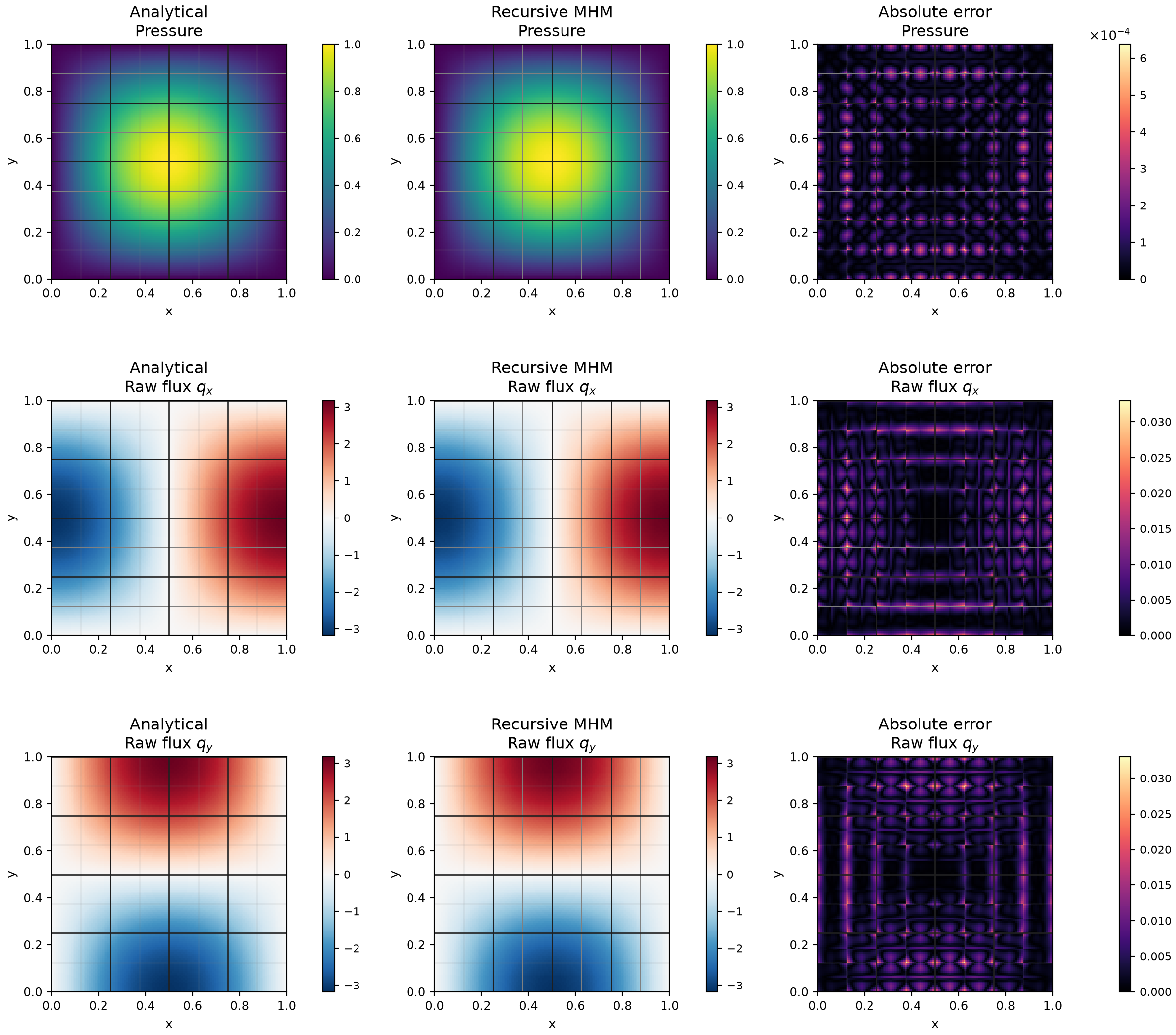
An outer MHM problem can use another MHM problem as each local solver. This application compares that recursive construction with a flat MHM system using exactly the same leaf meshes and approximation spaces.
Physical problem
On the unit square, permeability is the identity. Two boundary conditions share the same source:
The corresponding exact pressure is prescribed weakly on the whole exterior. The first problem has zero pressure there; the second has \(1+x-y\). These Dirichlet data fix the global pressure constant without a mean-pressure constraint.
Multiscale formulation and implementation
Each outer rectangle contains \(2\times2\) inner macrorectangles, each of which contains \(2\times2\) fine quadrilaterals. Leaf pressures use continuous \(Q_2\) and inner faces use \(P_1\) conormal traces. Two independent \(P_1\) segments per parent face exactly represent its two inner boundary faces.
Let \(A_{\rm in}x=b_{\rm in}\) be an inner hybrid system, including its retained constant modes. The selector \(P\) extracts its boundary trace and the signed map \(T\) injects the outer trace into that boundary. The outer local equation is
Thus \(P^{\mathsf T}x=T\lambda\). The parent continuity pairing is \(-T^{\mathsf T}\mu\). The outer global equation imposes pressure-jump moments and the stated exterior pressure moments. No projection or averaging changes the inner trace space.
The recursive MHM tutorial shows how the nested local problem delegates condensation to the shared local-problem machinery. The application notebook defines the two physical loads, inner and outer meshes, nested restriction, assembly and field evaluation. The executed numerical basis and its moments are retained for reconstruction at every level.
Results and reproducibility
Five outer mesh levels, from \(1\times1\) to \(16\times16\), give final measured orders 3.0019 for pressure L2 and 2.0009 for raw-flux L2. The relative physical difference between recursive and flat fields is at most \(7.01\times10^{-14}\). Their finest global systems have 2,432 and 5,248 unknowns, respectively; this unknown reduction is not a measured runtime speedup.
An independently assembled complete original Q2/P1 hybrid system verifies the same discrete geometry, sources, boundaries and spaces. This is a matching-system reference, rather than a classical conforming baseline. The exact solution supplies the accuracy assessment.
The full result report provides integrated norms, archive digests and reproduction commands. The displayed physical flux is the leafwise raw gradient; it is not an H(div) reconstruction, and macro conservation does not imply fine-cell conservation of that gradient.
References
- Christopher Harder, Diego Paredes and Frédéric Valentin (2013). A family of Multiscale Hybrid-Mixed finite element methods for the Darcy equation with rough coefficients, Remarks 7 and 10. DOI: 10.1016/j.jcp.2013.03.019.
- Christopher Harder and Frédéric Valentin (2016). Foundations of the MHM Method. DOI: 10.1007/978-3-319-41640-3_13.