Rectangular mixed elasticity
solve_elasticity_tensor_rt implements the quadrilateral weak-symmetry family
of Devloo et al. (2021),
Table 1 and section 4.3.2. For normal degree \(k\geq1\) and interior enrichment
\(n\geq0\), put \(s=k+n\). Each stress row retains RT normal moments through
Pk and all zero-normal interior modes of
\(Q_{s+1,s}\times Q_{s,s+1}\). Displacement is discontinuous \(Q_s^2\),
whereas the independent rotation uses total-degree \(P_s\).
Replacing that rotation space by Qs would change the published pair.
The default RT1/Q1/P1 pair contains the rigid motions. RT0/Q0/P0 is not offered as a mixed-elasticity family. Local stress normal degree, interior enrichment and macroface resolution remain independent. The default skeleton uses P1 on interior macrofaces and full fine-edge Pk on the external boundary; custom traces must have degree at most k and fine-edge-aligned segmentation.
The example helpers below are repository sources, supplied separately from the installed library. Open the corresponding notebook to acquire its verified companion, as described in the notebook guide.
from pymhm.meshes.cartesian import CartesianMacroMesh
from examples.formulations.application import weak_stress_elasticity as solve_elasticity_tensor_rt

solution = solve_elasticity_tensor_rt(
    CartesianMacroMesh(4), degree=1, enrichment=1,
    local_refinement=2, lame_lambda=1.e8,
    source=(1., 0.),
)
The geometry is an axis-aligned Cartesian rectangle mesh. Bilinear, curved or arbitrary quadrilateral mappings are outside this implementation. Lamé data may be scalar or callable; declared Cartesian material discontinuities must align with the fine rectangles. Ordinary callback discontinuities require the same alignment and appropriate integration from the caller.
Stress is the full Cauchy tensor, with H(div) continuity row by row. Its skew part is constrained through P_s moments and is not removed pointwise. The multiplier is negative physical traction; rotation approximates \((\partial_y u_x-\partial_x u_y)/2\). The finite-modulus hydrostatic identity, exact infinite-lambda pressure gauge and pure-traction rigid moments follow the mixed-elasticity conventions. The implementation uses the same stable bulk-compliance operation as the triangular families.
evaluate returns displacement, full stress, stress divergence and rotation.
errors integrates their L2 errors, using the Frobenius norm of the full stress.
fine_force_residuals, weak_symmetry_residuals,
normal_traction_residuals and equilibrium_residuals distinguish fine force
moments, weak symmetry, represented normal traces and macro force/moment balance.
These diagnostics test discrete identities; they do not quantify approximation
error by themselves.
The HPC4e geological cross-section uses the same family with the original heterogeneous material samples, 16 × 8 macrorectangles and 32 × 32 fine rectangles per macrocell. Four P1 skeleton resolutions reproduce the discretizations of the article's section 6.2.
Independent verification and numerical campaigns
Tests cover affine fields, a quadratic solenoidal field, finite and infinite lambda, nonzero mean pressure, heterogeneous smooth moduli, mixed traction and pure traction. Three native DOLFINx/UFL tests independently assemble compliance, divergence, asymmetry and load. Physical basis evaluation transforms Basix RT functions into the normal/interior basis and restricts the Qs rotation to Ps. This verifies the whole operator for RT1, RT1-plus and RT2.
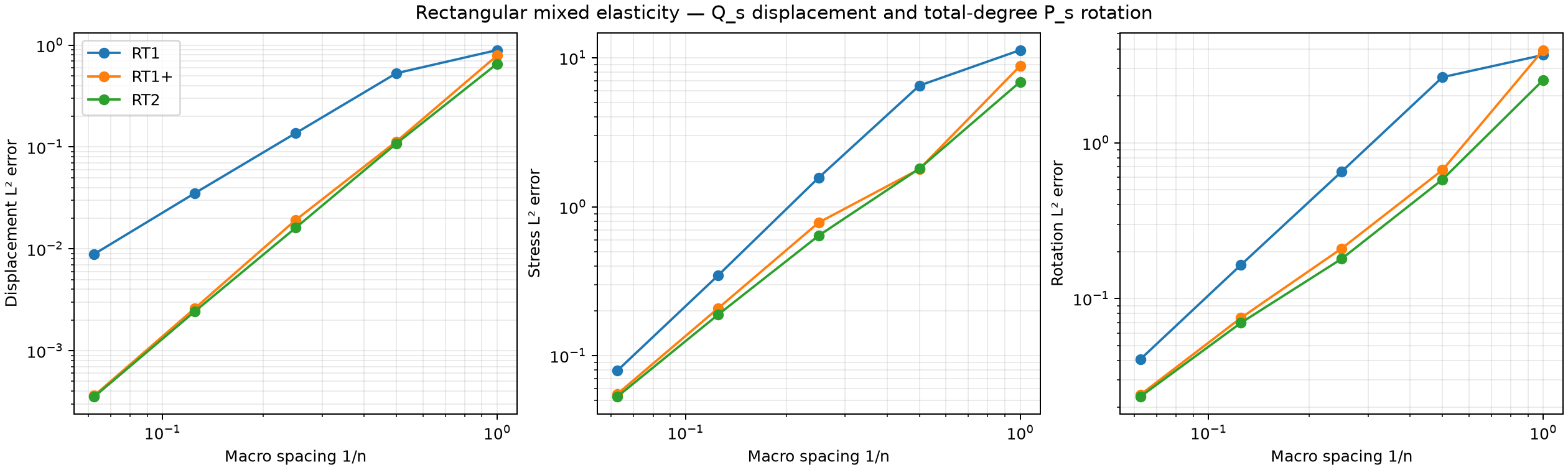
The original bounded-force polynomial field from
examples/elasticity_data.py is acquired on five grids
\(n=1,2,4,8,16\), one fine rectangle per macrocell. RT1, RT1-plus and RT2 retain
P1 interior macro traces; RT2 has P2 exterior traces. These declared spaces
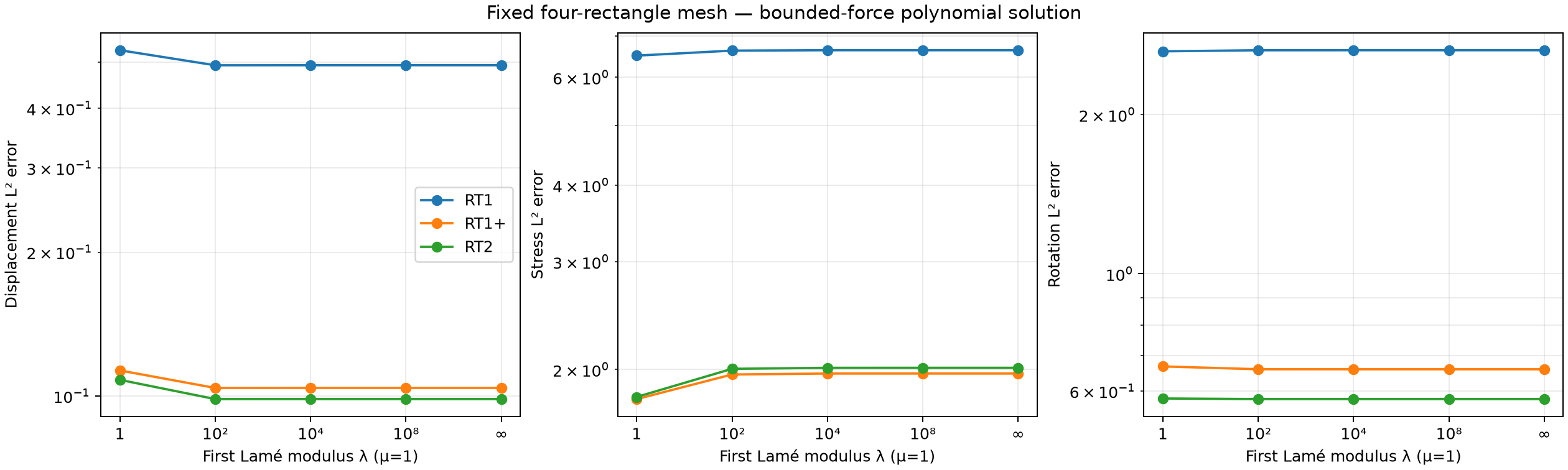
are not a historical table reproduction. A second study fixes four rectangles
and varies \(\lambda=1,10^2,10^4,10^8,\infty\), with \(\mu=1\).
Force and exact fields stay compatible and bounded in that limit. Finite
errors on this fixed coarse space document the observed locking behavior;
they do not establish robustness for every heterogeneous contrast.
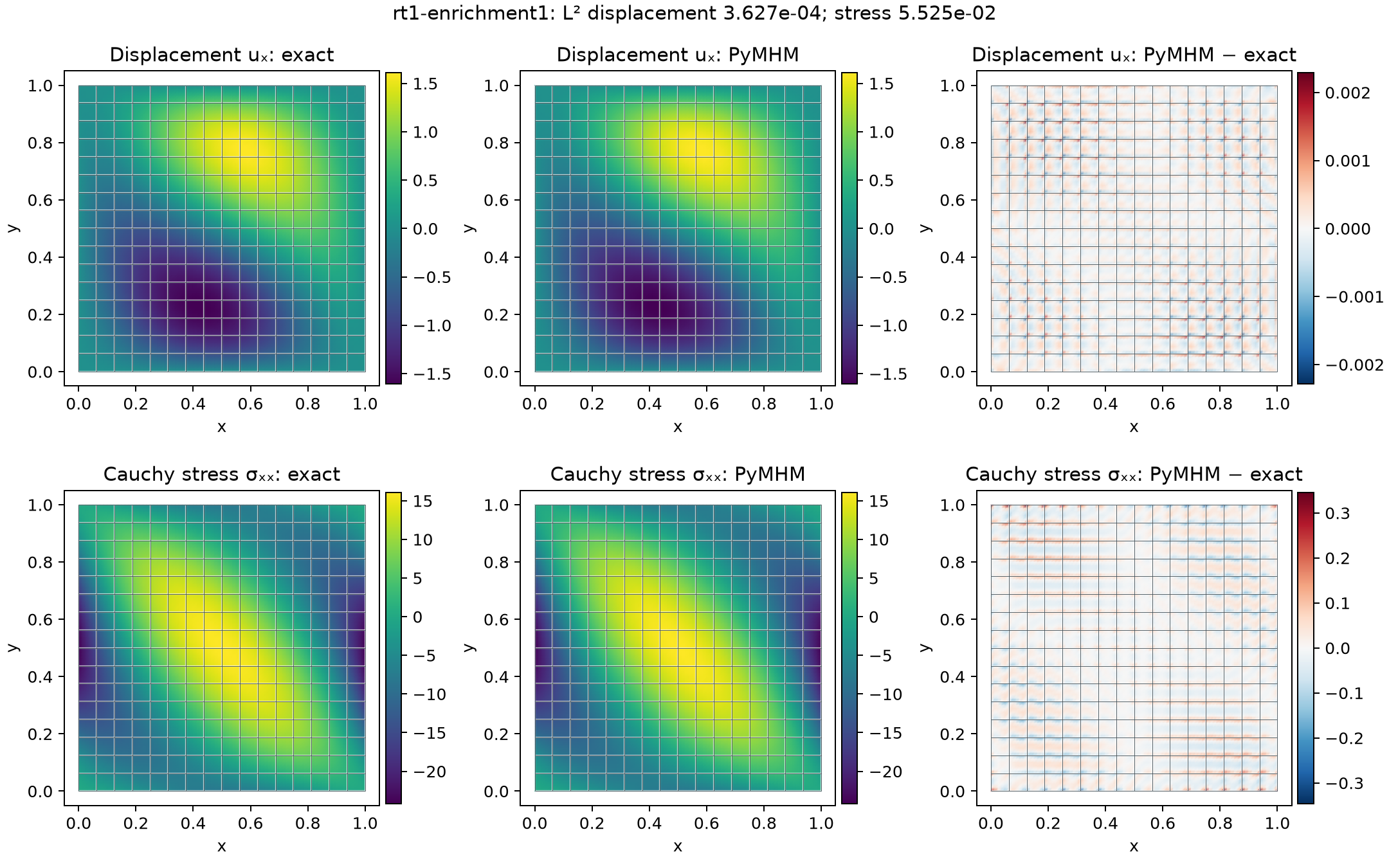
The spatial-map record retains the original and executed field identities separately. The map uses the recorded \(n=16\), \(\lambda=1\), RT1-plus case; displacement, stress and rotation norms agree with its retained values within \(3\times10^{-13}\) relatively.
pixi run --locked -e test-core python -m examples.solve_elasticity_tensor_rt --degree 1 --enrichment 1
pixi run --locked -e notebooks python -c "from examples.plot_elasticity_extensions import mixed_rectangular; mixed_rectangular()"
References
- Philippe R. B. Devloo, Agnaldo M. Farias, Sônia M. Gomes, Weslley Pereira, Antonio J. B. dos Santos, and Frédéric Valentin (2021). New H(div)-conforming multiscale hybrid-mixed methods for the elasticity problem on polygonal meshes, ESAIM: M2AN 55, 1005–1037. DOI: 10.1051/m2an/2021013.