H(div) stress and weak-symmetry elasticity
solve_elasticity_mixed solves plane-strain elasticity with a conforming normal
stress, discontinuous displacement, and an independent rotation multiplier.
Its default local spaces are BDM2 for each stress row, vector P1 for displacement, and
scalar P1 for rotation. These are the BDM2/P1/P1 spaces in Table 1 of the
Devloo et al. (2021).
The three rigid motions belong exactly to the local displacement space.
Additional BDM and enriched families retain these conventions
while independently varying fine-edge normal and interior polynomial degrees.
The default macroface traction is P1 on interior faces. On the exterior, P2 tractions are independent on each fine boundary edge. This preserves the local BDM2 boundary space. Users can supply aligned face partitions and degrees up to two; arbitrary alternatives still require the discrete stability checks.
Formulation and conventions
The physical equations and compliance are
This deviatoric/spherical form avoids subtracting almost equal terms when
\(\lambda/\mu\) is large. Both Lamé coefficients can be functions of physical
coordinates. Shear requires finite \(\mu>0\); \(\lambda\geq0\) also
accepts the exact incompressible limit np.inf, where the spherical compliance
vanishes. For a fully prescribed displacement boundary the finite-modulus
identity
fixes the hydrostatic mode. At infinite lambda, mean_pressure instead sets
the global mean of \(-\operatorname{tr}\sigma/2\); boundary volume flux must
vanish. Traction data determine the hydrostatic stress without this gauge.
With \(\operatorname{asym}\tau=\tau_{12}-\tau_{21}\), the local weak constitutive relation is
The independent rotation approximates \(q=(\partial_yu_x-\partial_xu_y)/2\). It is not computed by differentiating the discontinuous displacement. Stress symmetry is imposed through every local P1 moment of \(\operatorname{asym}\sigma\); pointwise skew stress is retained. The skeletal multiplier represents negative Cauchy traction, \(\Lambda=-\sigma n\).
The implementation uses three constrained local rigid modes. Their displacement parts are two translations and a rotation, and the rotation multiplier of the rigid displacement \((-y,x)\) is \(-1\). Constraints are physical displacement moments, with no independent rotation gauge.
A non-affine exact patch
The example helpers below are repository sources, supplied separately from the installed library. Open the corresponding notebook to acquire its verified companion, as described in the notebook guide.
import numpy as np
from pymhm import TriangleMesh
from examples.formulations.application import weak_stress_elasticity as solve_elasticity_mixed

def displacement(x):
    return np.column_stack((x[:, 0] ** 2, -2 * x[:, 0] * x[:, 1]))

solution = solve_elasticity_mixed(
    TriangleMesh.unit_square(2),
    lame_mu=1.0,
    lame_lambda=1e6,
    source=(-2.0, 0.0),
    dirichlet=displacement,
)
Here \(\operatorname{div}u=0\), and the exact fields are
The discrete stress and rotation contain these exact fields. Displacement is the cellwise P1 L2 projection of the quadratic field. On eight macrotriangles with local refinement two, its error is \(6.58808\times10^{-3}\) for \(\lambda/\mu=1,10^3,10^6\). The coefficient comparison verifies this P1 projection, including its nonzero displacement approximation error.
traction={face: value} prescribes physical outward \(\sigma n\). Other
boundary faces prescribe displacement. A pure-traction solve checks force and
moment compatibility and imposes three integrated displacement moments through
rigid_moments. A rigid rotation is included in that gauge; merely fixing mean
translation would leave the solution nonunique.
Smooth fields and five mesh levels
The analytical displacement is
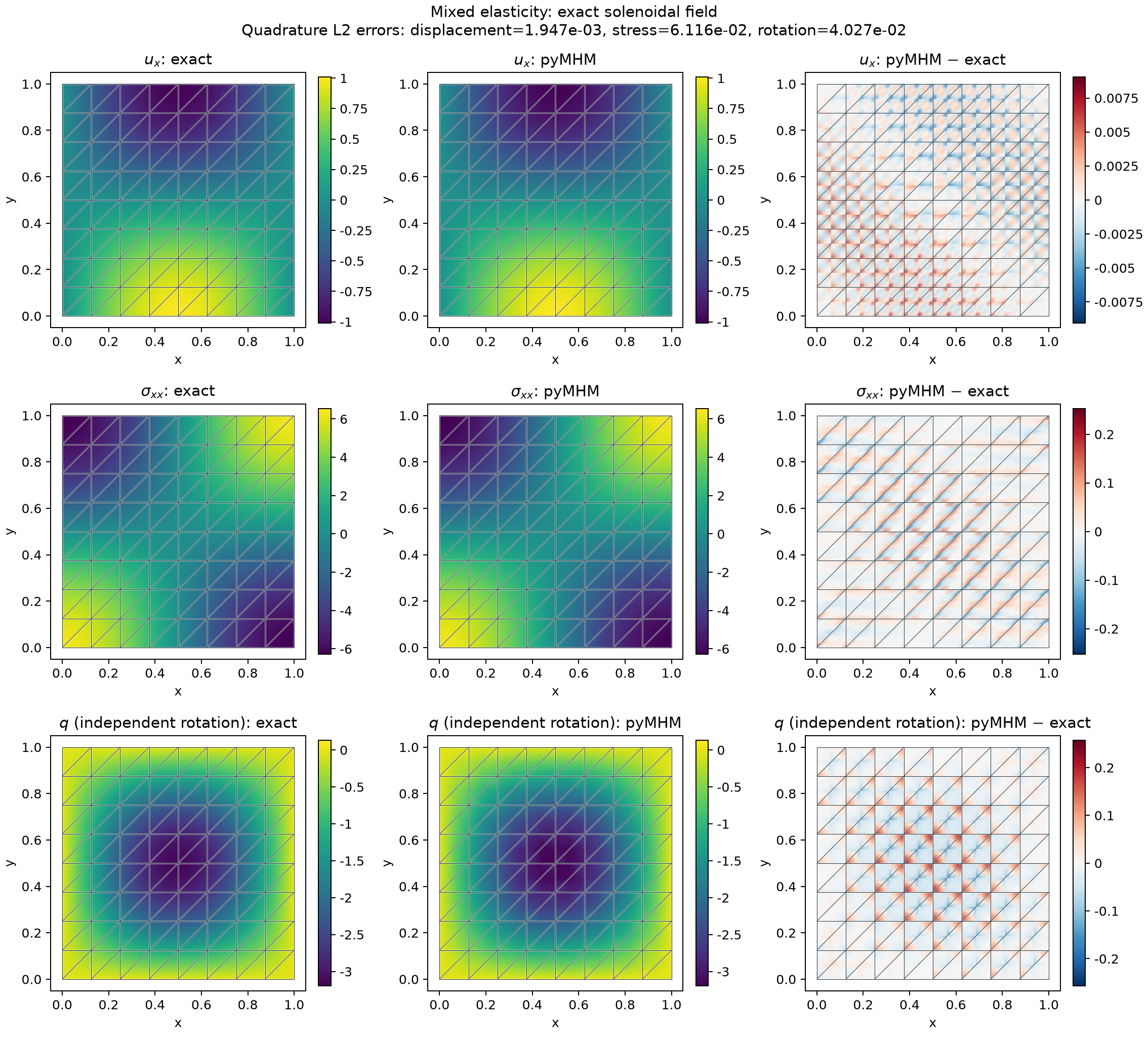
with \(\mu=1\). This solenoidal solution is independent of \(\lambda\). The maps below use 128 macrotriangles, four fine triangles per macrotriangle, and \(\lambda=1\). Every panel shows the actual macro boundaries. Exact and numerical panels share scales; the third column shows signed differences.
| Grid resolution n | Macrotriangles | Displacement L2 | Full stress L2 | Rotation L2 |
|---|---|---|---|---|
| 1 | 2 | 1.19467e-1 | 1.67050 | 4.75127e-1 |
| 2 | 8 | 5.22406e-2 | 7.80112e-1 | 4.94022e-1 |
| 4 | 32 | 9.51962e-3 | 2.30284e-1 | 1.53556e-1 |
| 8 | 128 | 1.94669e-3 | 6.11585e-2 | 4.02710e-2 |
| 16 | 512 | 4.52345e-4 | 1.56854e-2 | 1.01778e-2 |
The last mesh doubling gives displacement/stress/rotation rates of approximately 2.11/1.96/1.98. Rotation error increases between the first two meshes; the asymptotic trend is established by the subsequent levels.
The material sweep includes nine cases through \(\lambda/\mu=10^8\) and the exact incompressible limit; the last two panels use categorical abscissae.
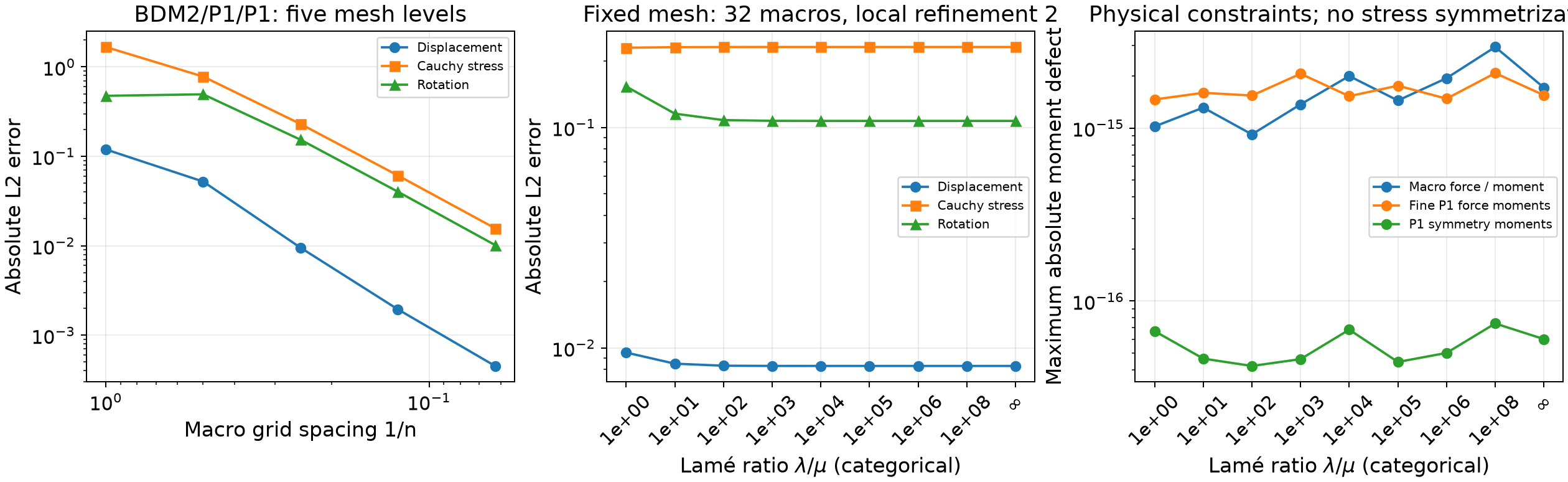
At fixed resolution \(n=4\), increasing \(\lambda/\mu\) from 1 to \(10^6\) changes displacement error from 0.00951962 to 0.00827563 and stress error from 0.230284 to 0.231981. The latter ratio corresponds to \(\nu=0.4999995000005\). The errors remain bounded while force, moment, and weak symmetry defects remain close to floating-point accuracy.
Section 5, Remark (iv), of the paper states independence of the estimates from Poisson ratio under its stability and regularity assumptions. The experiment checks that behavior for this family and these data. It does not establish robustness for arbitrary material contrast, meshes, or trace choices. At much larger Lamé ratios, roundoff in the weakly controlled mean hydrostatic stress can grow when nonzero boundary-volume terms nearly cancel. The physical finite-modulus identity divides that boundary quadrature uncertainty by the bulk compliance; this is distinct from discretization locking. A separate fixed-load polynomial bubble with homogeneous boundary data checks \(\lambda/\mu=10^{12}\) against the exactly incompressible solve, including stress and displacement coefficients.
Oscillatory Young modulus from the 2021 article
The analytical data from Section 6.1 are
The denominator of the first component is 27. The boundary displacement is the trace of this formula, including its nonzero values. The body force includes spatial derivatives of both Lamé coefficients. The example independently checks \(f=-\operatorname{div}\sigma\) by complex-step differentiation of the analytical stress before solving.
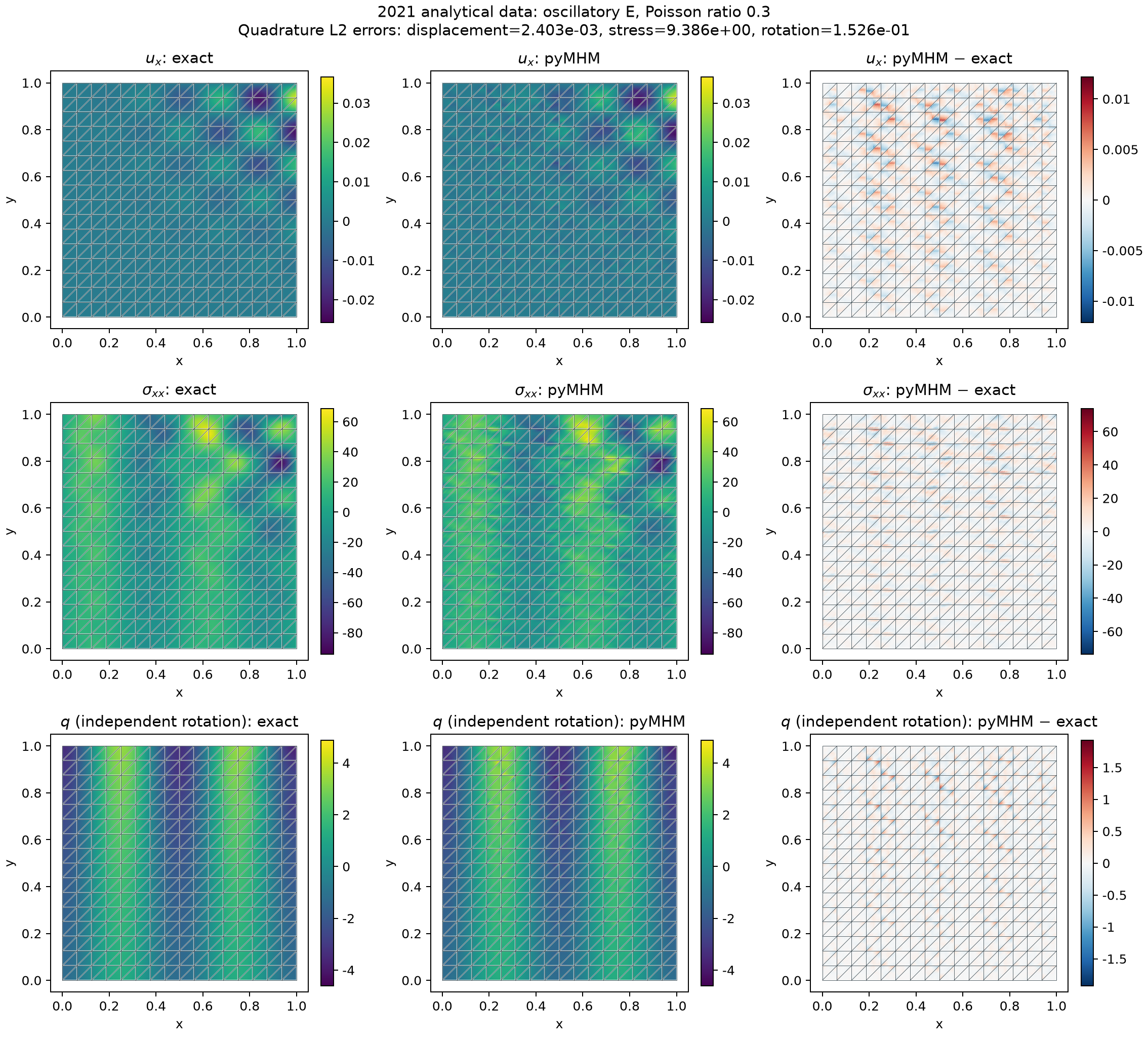
The spatial-map record identifies both executed cases. Integrated displacement, stress and rotation errors agree with the retained smooth and oscillatory configurations within \(7\times10^{-14}\) relatively.
On 512 diagonal macrotriangles with local refinement two, the measured errors are displacement 0.00240292, stress 9.38593, rotation 0.152634, and stress divergence 66.3344 in L2. The maximum fine P1 force-moment defect is \(1.85\times10^{-14}\). This distinguishes exact discrete equilibrium from pointwise approximation of a rapidly varying body force. The displayed stress retains its full tensor, including the pointwise skew part allowed by weak symmetry.
This is an analytical-case verification using published data on our stated mesh. It is not a reproduction of Table 3's ordinates or a NeoPZ execution. A separate aligned-layer regression checks a modulus contrast of 100, and an affine patch checks simultaneous spatial variation of \(\lambda\) and \(\mu\).
Independent assembly and reproduction
The oscillatory problem above is independently assembled with DOLFINx 0.9.0, UFL 2024.2.0 and Basix 0.9.0, using PETSc/MUMPS. The comparison preserves the Young modulus, Poisson ratio, exact nonzero displacement trace, fine triangles, local stress/displacement/rotation spaces and segmented macro traction space. UFL differentiates the Cauchy stress to obtain the body force independently. Native cell permutations are accounted for so both assemblies integrate at the same physical Duffy points.
A monolithic conforming stress operator is restricted by independently assembled Basix normal moments to the declared MHM traction subspace. Interior macrofaces retain P1 traction in the BDM2/P1/P1 comparison; exterior fine edges retain P2. The restricted system represents these same MHM approximation spaces. DOLFINx assembles the conforming operator; the comparison application supplies the macroface restriction and solves the complete saddle system. No PyMHM local matrix or condensed operator enters that solve, and no built-in DOLFINx MHM controller is assumed.
The physical differences on the three gallery meshes are:
| Resolution n | Macrotriangles | Relative stress L2 | Relative displacement L2 | Relative rotation L2 |
|---|---|---|---|---|
| 4 | 32 | 6.901e-14 | 1.029e-13 | 7.544e-14 |
| 8 | 128 | 1.362e-13 | 3.248e-13 | 2.075e-13 |
| 16 | 512 | 5.914e-13 | 4.613e-13 | 8.113e-13 |
Norms integrate the full stress tensor and independent displacement and rotation fields over every fine triangle, using orders 10 and 12. Each denominator is the corresponding native field norm. These small differences establish agreement of the matched discrete operators; the analytical errors reported above quantify discretization accuracy.
The independently assembled reference is MHM via trace restriction: monolithic DOLFINx/UFL assembly and a separately assembled restriction of normal tractions on macrofaces. The comparison also supplies the enriched stress coordinates. The table retains integrated displacement, stress and rotation differences; reconstructing their comparison maps requires the separate original coefficient archives. The analytical and PyMHM field maps above use the stated smooth and oscillatory physical problems.
The enriched-family comparison also verifies all four nominal Table 3 branches against this independent assembly. Historical connectivity/mesh-size conventions and inconsistent printed rotation entries remain unresolved. The evidence therefore establishes the published physical problem in the explicitly stated spaces, alongside its convergence study; it does not identify these ordinates as a literal reproduction of Table 3.
The complete numerical record contains 19 accepted same-case comparisons, source and archive digests, quadrature checks and native build provenance. The verified upstream source is DOLFINx v0.9.0. Separate native integration tests additionally check polynomial patches, BDM normal-moment orientation and the three-dimensional local rigid kernel.
Run the package's analytical gallery with:
Numerical records contain the errors and defects. Plot fields are sampled independently within each fine triangle, preserving broken one-sided values. P2 stress is sampled on nine display subtriangles; reported norms use separate order-10 quadrature, not the display interpolation.
References
- Philippe R. B. Devloo, Agnaldo M. Farias, Sônia M. Gomes, Weslley Pereira, Antonio J. B. dos Santos, and Frédéric Valentin (2021). New H(div)-conforming multiscale hybrid-mixed methods for the elasticity problem on polygonal meshes, ESAIM: M2AN 55, 1005–1037. DOI: 10.1051/m2an/2021013.