Heterogeneous geomechanics: HPC4e
Devloo et al. (2021), section 6.2 consider a vertical cross-section of the HPC4e geological model under gravity. This case uses the published rectangular weak-symmetry MHM family, the original material samples and the four skeleton resolutions of Figures 10 and 11.
Physical data and approximation spaces
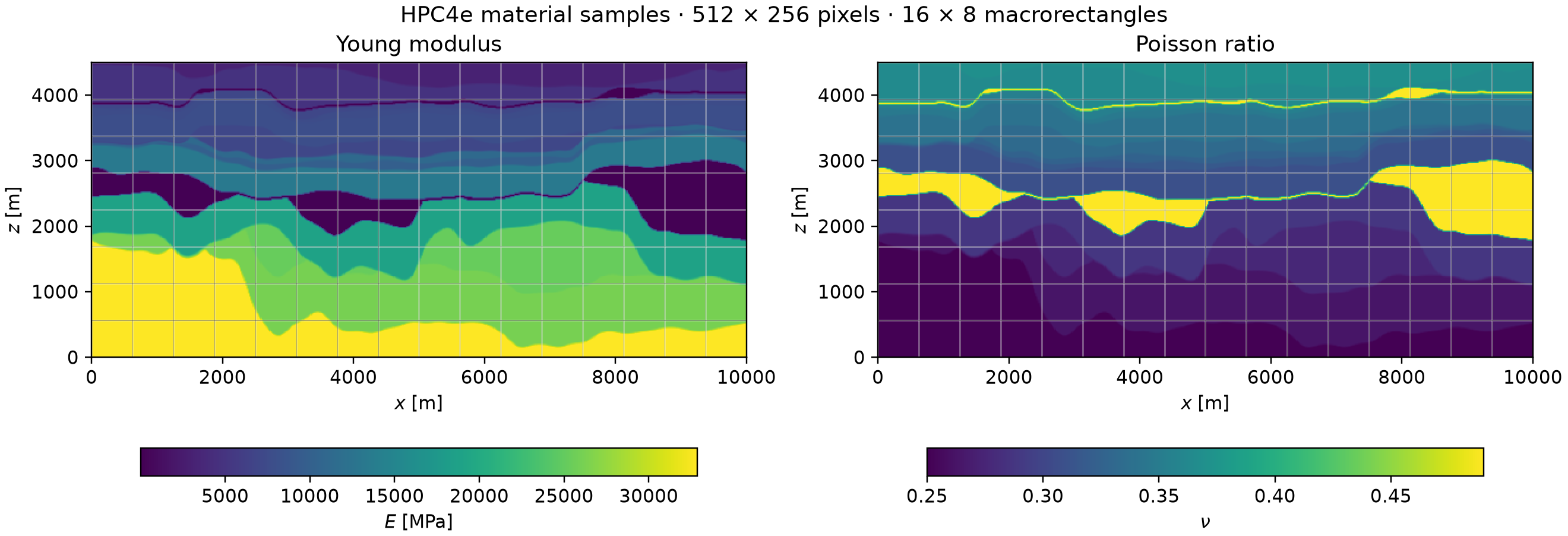
The domain is \([0,10000]\times[0,4500]\) m. The horizontal coordinate is \(x\), and \(z\) increases upward. The bottom is fixed, while the top and both lateral sides have zero traction. The body force is \((0,-9.81\rho)\) N/m³. Plane-strain Lamé moduli follow from the Young modulus and Poisson ratio:
The material arrays come from
labmec/MHM, revision f978f29d657d28fe58bcea20fabee68953093482, Data_13_Set.
VE, VPoisso and Vden contain Young modulus in Pa, Poisson ratio and density
in kg/m³, respectively. Their 512 × 256 samples already include the saturated-clay
layers with \(E=15\) MPa, \(\nu=0.49\) and \(\rho=1760\) kg/m³. Every sampled
value is retained, including intermediate interface samples. File depth indices
are reversed once to obtain upward height. Checksums pin all three arrays.
| Quantity | Published experiment and PyMHM setting |
|---|---|
| Macro partition | 16 × 8 rectangles |
| Local partition | 32 × 32 rectangles per macrocell; 512 × 256 globally |
| Stress | Row-wise RT1 with normal degree 1 |
| Displacement | Discontinuous Q1² |
| Rotation multiplier | Total-degree P1 |
| Interior enrichment | Zero |
| Skeleton | P1 on each of \(2^\ell\) subfaces; \(\ell=0,1,2,3\) |
| Material integration | Pixel-aligned fine cells, tensor Gauss rule of order 4 |
| Classical reference | Independent DOLFINx/UFL weak-symmetry mixed RT1 and RT2 |
The rotation is P1, not tensor-product Q1. Stress symmetry is enforced in rotation moments; pointwise symmetrization would change the field. The bottom displacement and zero normal stress on the other boundaries use the corresponding mixed weak and essential conditions. Three rigid modes per macrocell are retained in the condensed system.
Computations use \(x'=x/10^4\), \(u'=u/10^4\), \(\sigma'=\sigma/10^8\), \(E'=E/10^8\) and \(f'=10^4 f/10^8\). Thus the stress plots are in MPa and displacement plots are in metres. Scaling the modulus without scaling the force would change physical displacement.
Published stress profiles
The diagnostic line is exactly \(z=2250.25\) m. The coarse skeleton restricts traction transmission and can produce large stress oscillations. The expected published behavior is progressive agreement with the classical curve when the skeleton is refined, with the local grid and polynomial spaces held fixed.
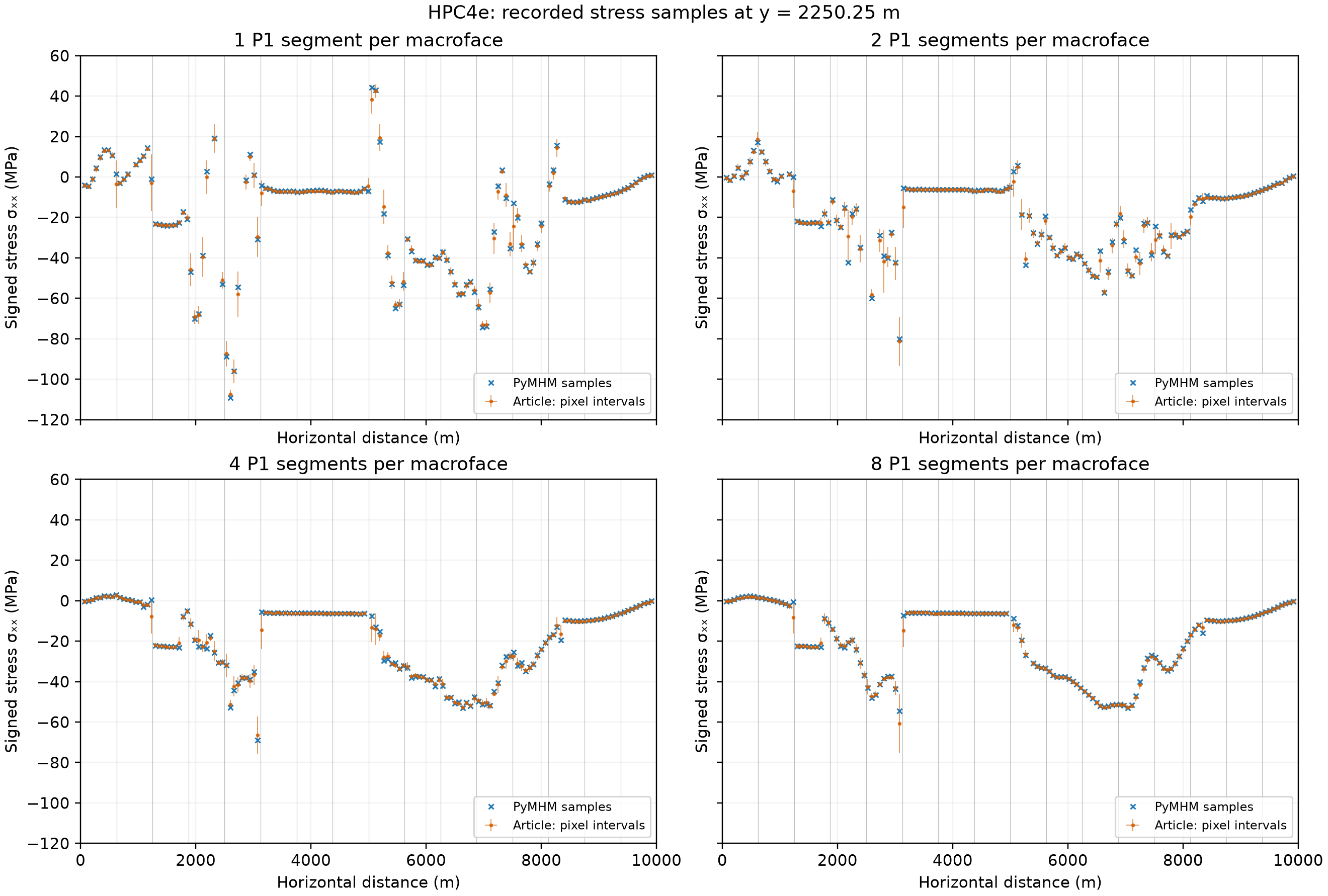
Crosses show the retained numerical point samples. Dots and error bars show the publication's digitized values and pixel intervals. The numerical markers are unconnected because those sample points do not determine the one-sided stress polynomial between them. Vertical lines mark the actual macro columns. The chart record identifies the retained point datasets and figure by their SHA-256 digests.
The comparison samples the red curves directly from the embedded publication
raster. Calibration uses the plotted coordinate axes. Each interval contains the
visible line thickness plus two pixels vertically; two pixels horizontally
correspond to 17.094 m. Columns with disconnected red bands are omitted. The
numerical profile is evaluated across the horizontal interval, retaining its
one-sided fine-cell values and exact piecewise-quadratic extrema. Interval overlap measures consistency with the raster,
not a continuum error bound. Nominal differences and the number of overlapping
intervals are preserved in examples/results/hpc4e/published-profile-comparison.json.
| Skeleton level | Global unknowns | Intervals agreeing | Nominal RMS difference [MPa] |
|---|---|---|---|
| 0 | 1376 | 139 / 139 | 1.550 |
| 1 | 2368 | 141 / 141 | 1.868 |
| 2 | 4352 | 143 / 144 | 1.372 |
| 3 | 8320 | 143 / 143 | 1.138 |
Overall, 566 of 567 sampled intervals overlap. The remaining level-2 interval is separated by 0.427 MPa. These raster intervals are too wide horizontally to certify narrow fine-cell extrema: the reconstructed PyMHM profile retains sharp features that the published plotting resolution may not resolve. Agreement at the sampled intervals therefore does not assert equality of every peak or pointwise agreement over the entire line.
Independently assembled reference
DOLFINx/UFL assembles the single-level stress/displacement/rotation system on the same material-aligned grid. Basix RT degrees 2 and 3 correspond here to mathematical RT1 and RT2. Displacement is discontinuous Q1² or Q2², and rotation has total degree 1 or 2. The displacement condition is imposed weakly; zero traction is imposed on all normal stress moments of the other boundaries. The RT1 acquisition uses Intel MKL PARDISO with explicit symmetric matching. The RT2 acquisition uses PETSc/MUMPS pivoted symmetric-indefinite LDLt. Both use five symmetric Ruiz congruences. Residuals are checked against the complete unscaled UFL matrix, including the equations omitted by triangular storage during factorization. The reference does not use the PyMHM local matrices or condensation.
The two classical degrees and an RT2 spatial refinement check reference sensitivity independently of MHM skeleton refinement. Polynomial field conversion is verified at independent physical points, including normal orientation and stress divergence. Errors use quadrature on a common material-resolved partition and the full nonsymmetric stress tensor. In addition to L2 norms, the compliance norm is
The classical acquisitions satisfy the original-equation and physical checks:
| Space and grid | Unknowns | Original residual of exported field | Relative force-equilibrium residual | Relative energy/work discrepancy |
|---|---|---|---|---|
| RT1, 512 × 256 | 3,542,016 | 8.18e−13 | 2.82e−13 | 2.26e−14 |
| RT2, 512 × 256 | 7,868,928 | 1.06e−12 | 2.46e−13 | 6.70e−15 |
| RT2, 1024 × 512 | 31,466,496 | 4.32e−12 | 4.86e−13 | 7.71e−14 |
The fine RT2 system uses four MPI ranks and MUMPS out-of-core LDLt. Five symmetric Ruiz congruences precede factorization; an explicit extended-precision defect correction reaches a relative residual of \(2.31\times10^{-15}\) in the original equations. The table reports the separately verified float64 exported field. The maximum simultaneous resident memory observed by the acquisition monitor was 107.18 GiB. The sum of the four individual rank peaks is 119.69 GiB; these quantities have different definitions. This is a concurrent scientific acquisition, not a parallel-performance measurement.
The reference has two distinct resolution checks. Increasing the classical degree from RT1 to RT2 on 512 × 256 cells changes stress by 1.96681%, displacement by 0.149563%, rotation by 4.34295% and compliance norm by 4.79411%, relative to RT2 on that grid. Refining RT2 from 512 × 256 to 1024 × 512 gives:
| Norm | Relative classical refinement increment |
|---|---|
| Stress L2 | 1.119129% |
| Displacement L2 | 0.010589% |
| Rotation L2 | 2.864135% |
| Compliance | 3.113395% |
The finer RT2 field supplies the denominators in this table and in the MHM comparisons below. These are measured increments, not upper bounds on the continuum error. Reference sensitivity remains material for the finest MHM field, particularly for compliance and rotation; the numerical reference is not an exact solution.
Against RT2 on 1024 × 512 cells, the four published MHM skeletal spaces give:
| Skeleton level | Stress L2 difference | Displacement L2 difference | Rotation L2 difference | Compliance difference |
|---|---|---|---|---|
| 0 | 25.424% | 12.955% | 33.773% | 30.256% |
| 1 | 18.310% | 7.056% | 24.503% | 21.859% |
| 2 | 5.579% | 1.160% | 12.352% | 9.474% |
| 3 | 4.159% | 0.625% | 8.203% | 7.339% |
Tensor Gauss orders four and five agree to \(2.05\times10^{-14}\) relative for these displacement, stress, rotation and compliance differences, including the RT2 spatial-refinement comparison. The integration grid resolves all material pixels and both fields. Divergence differences are about \(1.9\times10^{-10}\) in dimensionless L2; their quadrature changes, normalized by the reference divergence norm, are at most \(3.83\times10^{-17}\). The spatial-refinement and MHM records and degree-refinement records include absolute norms and input checksums.
The separate same-space RT1 comparison is:
| Skeleton level | Stress L2 difference | Displacement L2 difference | Compliance difference |
|---|---|---|---|
| 0 | 25.355% | 12.808% | 29.855% |
| 1 | 18.197% | 6.917% | 21.307% |
| 2 | 5.141% | 1.029% | 8.085% |
| 3 | 3.544% | 0.493% | 5.440% |
These are relative differences from the classical RT1 field, with its norm in the denominator. The same-space complementary-energy identity is
It holds here to \(3.29\times10^{-14}\) relative to the total compliance energy, and \(1.12\times10^{-11}\) relative to the energy difference. This tests the nested discrete stress spaces, equilibrium and weak-symmetry constraints. It is not a bound on the error relative to the continuum solution, and it must not be applied automatically between RT1 and RT2 rotation/displacement spaces.
Full displacement and stress comparison maps require the separate original RT2 reference coefficient archive on \(1024\times512\) cells. This report publishes the actual material map, retained signed-stress samples and integrated comparison norms. The point samples are distinct from the full-field quadrature used for the norm and complementary-energy comparisons.
Algebraic and physical checks
Fine-cell force moments, macro force and moment balance, represented normal traction continuity and weak stress symmetry are checked separately. These identities assess the discrete equations; they do not replace the classical reference or the published-profile comparison.
An additional complete RT1, \(\ell=0\) solve compares SciPy SuperLU and Intel MKL PARDISO's symmetric-indefinite factorization. Relative differences are \(2.49\times10^{-9}\) in stress L2 and \(1.26\times10^{-8}\) in compliance norm. Both solvers satisfy the same physical residual gate. These numbers describe backend agreement; concurrent execution times are not a controlled speedup study.
The small automated tests use polynomial patches to verify dimensional scaling, material orientation, canonical odd normal moments and analytical L2/compliance integrals. The full geological acquisitions are research cases outside the CI suite.
Reproduction
The reference driver defaults to --workspace-limit-mb 0, letting MUMPS size
its work arrays from the analysis estimates. A positive value specifies MB
per MPI process and can enlarge the allocated work arrays; it is not a
node-wide memory budget. See the MUMPS user guide,
ICNTL(23), for the allocation convention.
pixi install --locked -e intel
pixi run --locked -e test-core python -m examples.solve_hpc4e_mhm --download --segments 1 2 4 8 --workers 8
pixi run --locked -e fem python -m examples.solve_hpc4e_reference --degree 1 --factorization pypardiso-symmetric-matching --solver-python .pixi/envs/intel/bin/python --equilibration symmetric --threads 4
pixi run --locked -e fem python -m examples.solve_hpc4e_reference --degree 2 --factorization ldlt --equilibration symmetric --threads 4 --workspace-limit-mb 80000
pixi run --locked -e test-core python -m examples.compare_hpc4e
pixi run --locked -e test-core python -m examples.compare_hpc4e_fields --workers 4
pixi run --locked -e fem mpiexec -n 4 python -m examples.solve_hpc4e_reference \
  --nx 1024 --ny 512 --degree 2 --factorization ldlt \
  --equilibration symmetric --mpi --threads 2 --refinement-precision extended \
  --workspace-limit-mb 17500 --out-of-core-directory build/tmp/hpc4e-mumps-ooc
pixi run --locked -e test-core python -m examples.compare_hpc4e_fields --workers 2 \
  --reference build/results/hpc4e/classical-rt2-1024x512-mumps.npz \
  --approximations build/results/hpc4e/classical-rt2-512x256-mumps.npz \
    build/results/hpc4e/mhm-s1.npz build/results/hpc4e/mhm-s2.npz \
    build/results/hpc4e/mhm-s4.npz build/results/hpc4e/mhm-s8.npz \
  --orders 4 5 --output examples/results/hpc4e/reference-spatial-refinement.json
pixi run --locked -e notebooks python -m examples.plot_hpc4e \
  --reference build/results/hpc4e/classical-rt2-1024x512-mumps.npz
The recorded stress-sample chart above can be rendered without the complete coefficient archives:
pixi run --locked -e notebooks python -c "from examples.plot_hpc4e import recorded_profiles; recorded_profiles()"
The dataset manifest records the public data source, revision and checksums. Numerical records identify the approximation spaces and source hashes. The reference implementation described in the paper is NeoPZ; the classical reference results reported here use DOLFINx/UFL and are identified accordingly.
References
- Philippe R. B. Devloo, Agnaldo M. Farias, Sônia M. Gomes, Weslley Pereira, Antonio J. B. dos Santos, and Frédéric Valentin (2021). New H(div)-conforming multiscale hybrid-mixed methods for the elasticity problem on polygonal meshes, ESAIM: M2AN 55, 1005–1037. DOI: 10.1051/m2an/2021013.